
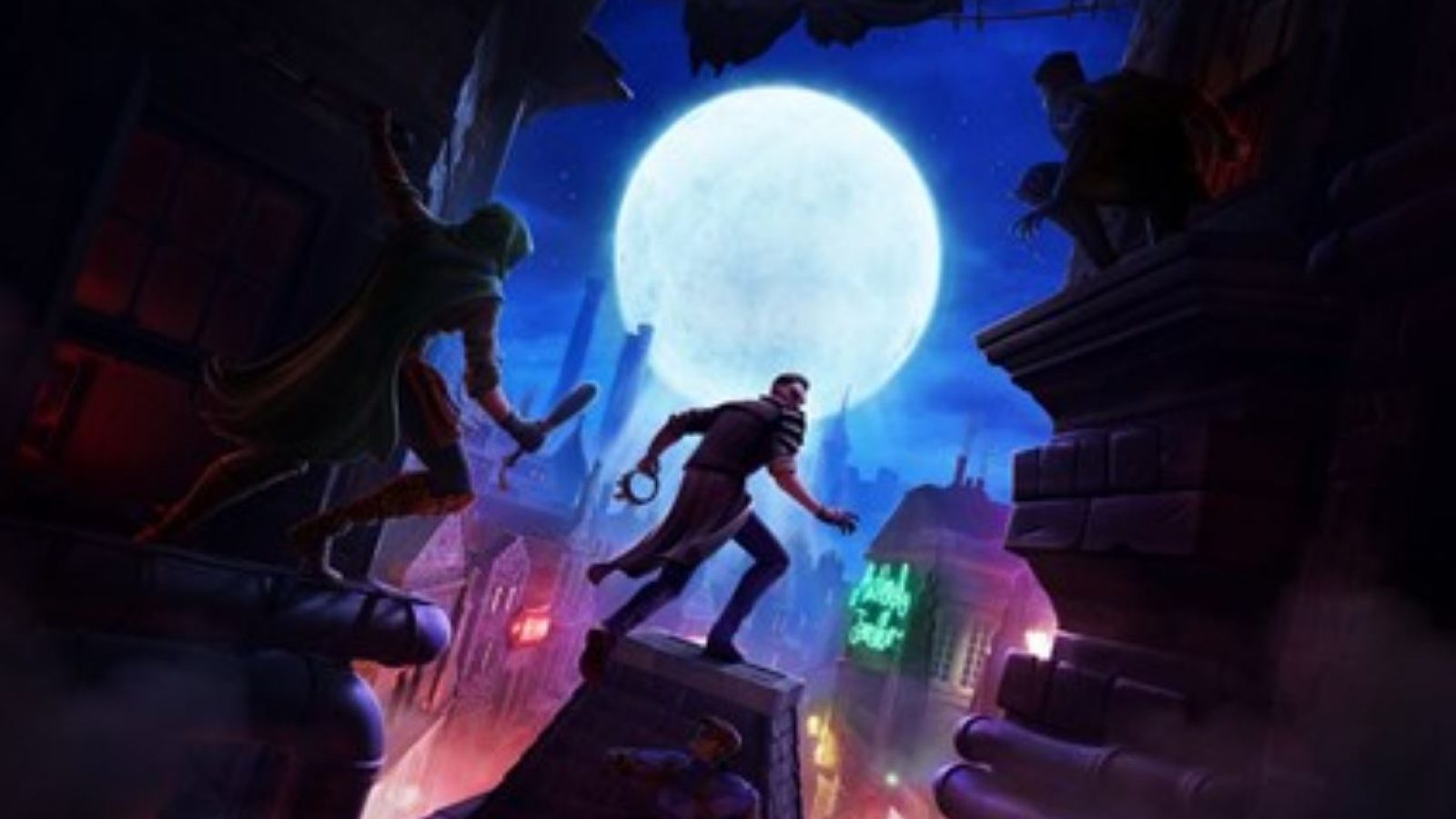
Everyone's looking for their partner-in-crime in life, and Thick as Thieves lets you literally commit crimes with your best bud, in its two-player co-op stealth experience. Or, if you want to keep all the loot for yourself, you'll still be impressed going solo by its immersive world and gameplay. We chatted with Game Director Jeff Hickman about how he and the team at OtherSide Entertainment brought the game to life, and attempted to revive a certain kind of stealth action immersive sim. Read the full interview below:
Q: It feels like stealth action, particularly first-person stealth action, has been quite a quiet genre in recent years. Why do you think this is and how does Thick as Thieves revive this beloved genre?
Hickman: "I actually think that stealth games exist all over the place, but they have been subsumed into other game genres as pieces and parts of those games. People really crave and love the idea of stealth, but it has to be done right.
I think Stealth Action games, especially ones with the type of emergent gameplay that Thick as Thieves has, is a difficult type of game to nail. The interplay between light and dark can be subtle at times and dramatic at other times. It takes a special team to find the fun in this type of game. And we have exactly the team to do it. Beyond that, I do think that these types of games don't follow an easy pattern for developers, and therefore they are a little risky for any team taking them on. We are willing to take that risk to make a super fun game for our players."
Q: When people think about the best of stealth action, they often think of amazing level design. What can you tell us about the process of making memorable and replayable in-game areas?
Hickman: "You will hear me mention the interplay between light and dark a lot. This is critical to the spaces that we make. We look at an idea for a new map with light and dark at the forefront, but we also are looking at entry and exit points, the space for a thief to move around, where we want the choke points, where we want security, etc... One of the initial things we do once we have a rough blockout of the space and the flow is to designate "hot" and "cool" zones. Players should always be confronting the choice of leaving a safe location to go through something that isn't safe to get to another safe location. The space also needs to make sense within the story and world that the player is moving through. It's super important not to jar the player into a sense of disbelief - gameplay and the fiction need to be in balance. This also makes each space memorable - a map that makes sense, a story that brings it together, and challenging but not punishing gameplay that players love."
Q: How do you balance challenges and benefits with the co-op aspect, so players don't feel overpowered or punished for bringing along a partner in crime?
Hickman: "It's actually pretty straightforward. We always err on the side of fun and giving rewards instead of withholding them. COOP players always share every piece of loot and reward within the level. You succeed together and are given all of the rewards that you have earned as a team - it's not competition, it's collaboration. If players want more difficulty, turn it up to Master Thief - we test it all the time; we've played this game more than anyone on the planet, and it's still a challenge for us, one that we enjoy."
Q: In the gameplay trailer, it looks like chaos breaks out once our criminals have stolen the artefact they're looking for. Is there always a frantic escape or will players get the chance to enter and leave like a ghost if they play their cards right?
Hickman: Actually, we encourage a more thoughtful escape, though the frantic escape can happen 🙂 There is some time pressure that adds some tension to the escape, but sprinting at ANY time in our game is a dangerous proposition - our guards and especially the Haunstable are very sensitive to noise, and running - especially on hard surfaces - makes a lot of it. Proceed with caution! Sometimes the fastest way to move is also the quietest.
Q: On an average run, how long does it take to beat Thick as Thieves, and is there a sense of replayability with the levels to keep players coming back?
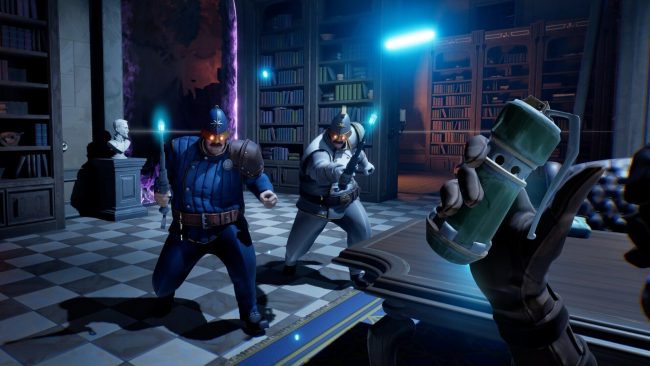
Hickman: "Are we talking about a single match?. The quick answers are, within 45 min, and YES! Now some details. Each match has a max length of 45 minutes. The player can choose to spend as much of that time as they desire or need. For a skilled player, many of the matches can be completed in 20 minutes or less, but you probably won't get all of the loot in the level, and moving fast is a dangerous way to play.
Replayability? You got it! Each map has three difficulty levels and also has a large number of variants in mission type, guard and trap placement, clues, and entry and exit points. Your favorite hatch might be boarded over, or that door in the basement could be blocked with a stack of boxes. The world isn't infinitely variable, but there are enough differences to keep you on your toes. And of course, once you've gotten the handle of playing with the Spider and the Zipwire, playing with the Chameleon and Disguise puts a different spin on things.
If we're talking about "beat the campaign", we've got a 16 contract sequence that is the main story for this chapter. We're calling it "4+ hours" because by about 4 hours in, you will have seen all of the main elements of the game. Honestly, it took me about a dozen hours to complete it the first time, but I've done it half a dozen times since then, so yes, I do think there's a value to replay - especially with co-op."
Q: Some stealth games feel like they make a player load saves over and over until they get the perfect run. Are thieves punished for triggering alarms and alerting enemies, or are they more incentivised to play through a level as they see fit, adapting to scenarios as they evolve?
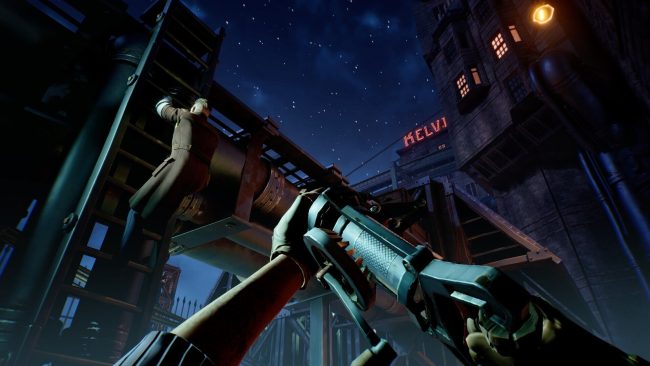
Hickman: "The latter. We aren't big on punishment - players already have a challenging task, namely to get in and get out with the loot. We want the players to approach each map, mission and room and use some clever thinking on how to solve each element. Each room is an obstacle. Figuring out how to get through or bypass it is where a bunch of the fun is. Use your gear, fool the guards, turn off the traps, climb through the rafters, go through the tunnels - it's all up to you.
There are no saves - the game has been architected to be multiplayer from the very beginning, so no pauses, no saves. Rather than inching through the world puzzle by puzzle and "save-scumming" to get through something extraordinarily difficult, we've given the player some very powerful tools, and then it's up to them to set the difficulty appropriately. But, like all good stealth systems, if you kick the hornet's nest, it needs to reset. Players are going to get detected - detection equalling failure is one of the novice mistakes that people who dabble with stealth make early on; it's binary and unforgiving and frustrating. As a player, you need to be able to recover from your mistakes, and if you're successful in removing yourself from an alerted situation, the world needs to reset and let you re-approach it. That doesn't mean that everything is exactly the same - some guards will remain in a heightened state of alertness; perturbing a guard multiple times can incite new investigation behaviours, but the general rule is "choice, consequence, and recovery" - recovery is where a lot of the fun happens."
Q: Does your experience in MMOs and online experiences assist in making the co-op of Thick as Thieves feel an integral part of the overall experience?
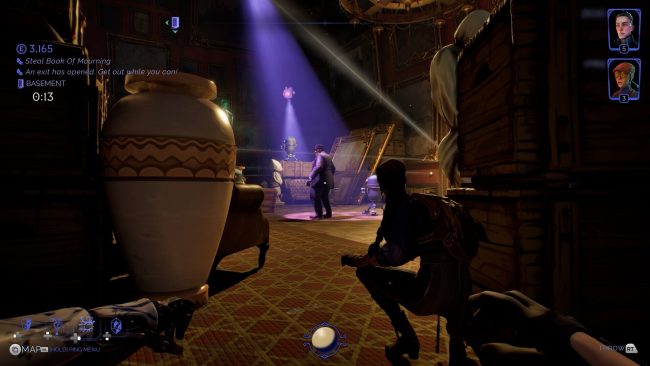
Hickman: "Definitely. I spent two decades working in online, multiplayer games. One thing that I have learned, playing solo can be really great, but playing with friends can be even better. Make coop as easy to get into as possible, make the rewards work for both players, provide tools that help players play together and never penalize players for playing together."
Q: The city of Kilcairn feels like a strong character in its own right. How does having an immersive setting help enrich the overall experience of Thick as Thieves?
Hickman: "It's a wonderfully mysterious city to explore. We have a whole world of alternate history, stories, people to draw from and share. The story, alongside the visual expressions of the world and Kilcairn, really bring a sense of "familiar but different" to the game. We lean into the story to give context to why you are there - in this opening chapter, you're a new thief; you've just arrived, and you need to prove yourself. The very first mission you go on ends up being part of a much larger mystery, but also gives you a tool that will prove critical in your endeavours. THEN we expand the story to involve the player in the machinations of the greater world and politics. There may even be a few references to people (fictionalized versions of course) that folks have heard of before. I hope the players find it as fascinating as we do."
Q: If you could use any of the in-game gadgets in real life, which one would you choose and why?
Hickman: "Ooooh. Probably the Insult Fairy. It's truly comical in its insults and provides amazing distractive qualities without YOU being tagged as the insulter. Using it on my kids when they don't expect it would be hilarious. Maybe distract my wife so I can play more videogames ;)"
