

Cloud Strife is arguably the face of Final Fantasy, isn't he? With his boyband good looks, Super Saiyan hairstyle, and all the charisma of a cushion-less rest stop, it's easy to see why so many have come to love him. But there's one thing that's even more recognisable than his luscious blonde spikes.
It's massive, it's sharp, and when it's on his back, sitting or crouching is no longer an option. That's right, the iconic weapon that is the Buster Sword. Cloud's oversized slab of steel has become one of gaming's most iconic weapons, appearing in countless spin-offs, crossovers, and even Super Smash Bros.
Originally passed down from Angeal Hewley to Zack Fair before eventually finding its way into Cloud's hands, the Buster Sword is as much a symbol of legacy as it is an instrument of destruction. Throughout Final Fantasy VII, Cloud swings it with impossible speed, carving through giant monsters, slicing into armoured machines, blocking bullets, and somehow performing acrobatic flips without toppling over backwards.
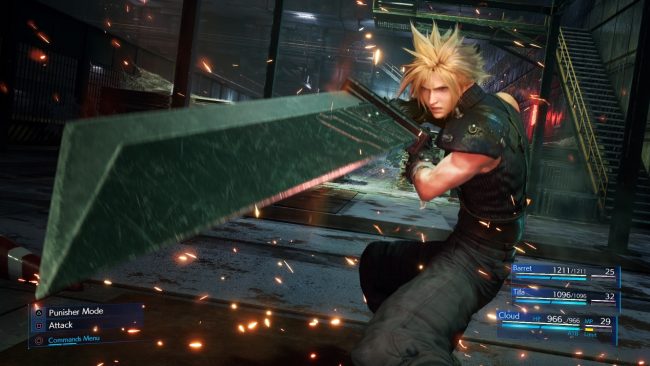
It's the kind of weapon that makes every encounter look effortlessly cool—provided you don't stop to think about the laws of physics. Because while the Buster Sword works perfectly in the world of SOLDIER enhancements and Mako energy, bringing it into the real world raises one very important question: could anyone actually lift the bloody thing, let alone fight with it the way Cloud does?
Final Math-tasy
To work out just how ridiculous Cloud's signature weapon would be in the real world, we first need to make a few assumptions. Cloud is generally depicted as around 173 cm (5' 8") tall, so if we take the Buster Sword as being roughly his height, that gives us a blade around 1.7 metres long.
The sword is also enormous when compared with a conventional great sword. Based on its proportions, we can estimate the blade at roughly 26 cm wide and 4-5 cm thick. Assuming it is made from solid steel, we can use some quick maths to figure it out.
- Buster Sword: ~1.7 m long
- Blade width: ~26 cm (0.26 m)
- Blade thickness: ~4-5 cm (0.04-0.05 m)
If we simplify the blade into a rectangular block, we can estimate the volume of steel:
1.7 × 0.26 × 0.045 ≈ 0.0199 m³.
Steel has a density of approximately 7,850 kg/m³, so we can multiply that with the amount of steel to find its mass.
0.0199 × 7,850 ≈ 156 kg
However, that's the weight of a perfect rectangular block. The actual Buster Sword isn't a solid rectangle: it tapers, has angled edges, the tip isn't square, and there are other areas where material is removed. So, in that case, we can take a good chunk of that weight off. For argument's sake we'll take the relatively conservative weight of 120 kg for the sword (for simplicity's sake, we'll ignore the hilt).
That's really quite heavy.
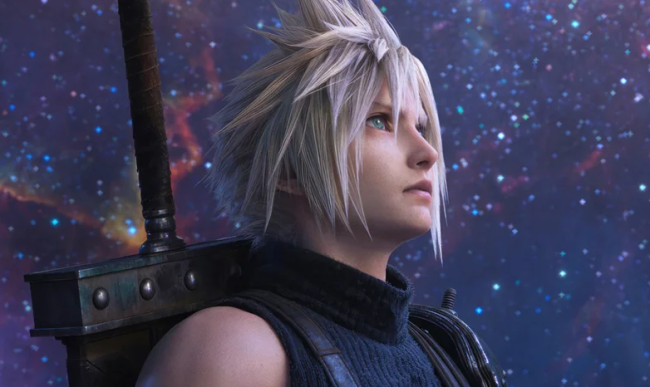
Now, you might think someone who can deadlift 120 kg could theoretically wield a 120 kg sword. But a barbell keeps its weight close to your body. The Buster Sword is effectively a 1.7-metre-long lever, with its centre of mass roughly 0.8-1 metre from Cloud's hands. That changes things massively.
Simply holding a 120 kg sword horizontally would create an enormous rotational force at the hands and shoulders. In other words, his muscles wouldn't just be supporting 120 kg; they'd be fighting the enormous rotational force created by having that weight hanging a metre away from his body.
And swinging it is even worse.
That brings in more maths and forces that will make it feel much heavier than its base weight. Then he has to stop it. Then reverse direction. Then do it again. And that's before we get into Cloud's habit of throwing the thing around one-handed, jumping with it and performing elaborate aerial combos.
That's a lot of force to put your shoulders, elbows, spine, and wrists through. A world-class strongman like Eddie Hall might be able to pick up a sword this heavy. They might even manage a few slow swings. But wielding it like Cloud would require not only extraordinary strength, but bones, tendons, and joints capable of surviving forces far beyond those experienced by a normal human.
So, a faithful Buster Sword is out of the question. But is it possible to make something that's close to it?
Can we make the Buster Sword wieldable?
We've established the Buster Sword is far too heavy for a normal human to wield. I know, I'm as shocked as you are. But this is where things get interesting. What kind of Buster Sword could be wielded?
While we could think about the shape and build of the sword itself, and how to make it less ridiculous and more manageable, where would the fun in that be? We'd just end up with a claymore or a broadsword.
The easiest solution is to change what the sword is made from. Our 0.0199 m³ block of steel weighs roughly 156 kg, but different materials give us some dramatically different numbers.
Given the differing densities of regular earth materials, here are some considerably lighter options we could have.
- Titanium: ~90 kg
- Aluminium: ~54 kg
- Magnesium: ~35 kg
- Carbon fibre: ~30-35 kg
Bearing in mind this is ignoring the hilt, suddenly, our sword is looking a lot more manageable.
Titanium seems like the obvious choice. It's significantly lighter than steel while retaining an excellent strength-to-weight ratio. Unfortunately, even at around 90 kg, we'd still be asking Cloud to swing the equivalent of a person around. Not ideal.
Aluminium gets us down to around 54 kg, still mega heavy, but getting there. An exceptionally strong human could conceivably pick that up and manipulate it. But aluminium is considerably less stiff than steel and simply swapping one material for another wouldn't necessarily produce a sword capable of surviving the punishment Cloud dishes out. It likely wouldn't be an effective weapon for very long.
Magnesium could bring the weight down to around 35 kg, while a carbon-fibre composite could potentially get us into the 30 kg range. At that point, we're no longer talking about an impossible weight. We're talking about something an exceptionally strong person could conceivably swing.
There is, however, an even better solution. A blend of several metals.
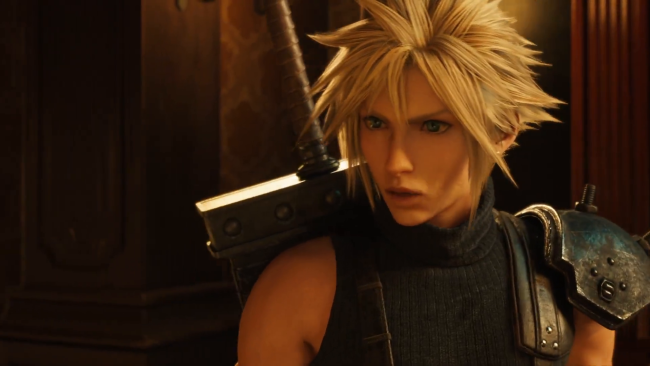
In 2013, Hollywood armourer Tony Swatton made a replica of the Buster Sword and got himself into the Guinness World Records for it. He went for it too, with his blade made from a mix of aluminium, bronze, and steel, and measuring at a massive 2.59 meters, it still only weighed 21.65 kg.
That's a world away from our theoretical 120 kg steel monster.
But even at 20 kg, you're still swinging a 1.7-metre-long object at high speed. The sword's length, leverage, and rotational inertia don't magically disappear just because we've taken most of the weight out.
But at least we've moved from "this would break a human being" to "a sufficiently strong lunatic might actually be able to use it."
And honestly, that's probably the closest we're ever going to get to becoming Cloud without getting all hopped up on Mako.
TL;DR
Unless you've got some Mako lying around, don't try this one at home. At the very least, a lightweight Buster Sword is at the very edge of what's physically plausible. Whether you'd actually want to take one into combat is another question entirely.
By all means, this is all maths conjured up on an A-Level understanding of physics and calculations, so if you're reading this and tearing your hair out at some glaring error. Please do get in touch.
And if you have any ideas for any iconic gaming (or film) weapons you'd like to see given similar treatment, do let us know in the comments.