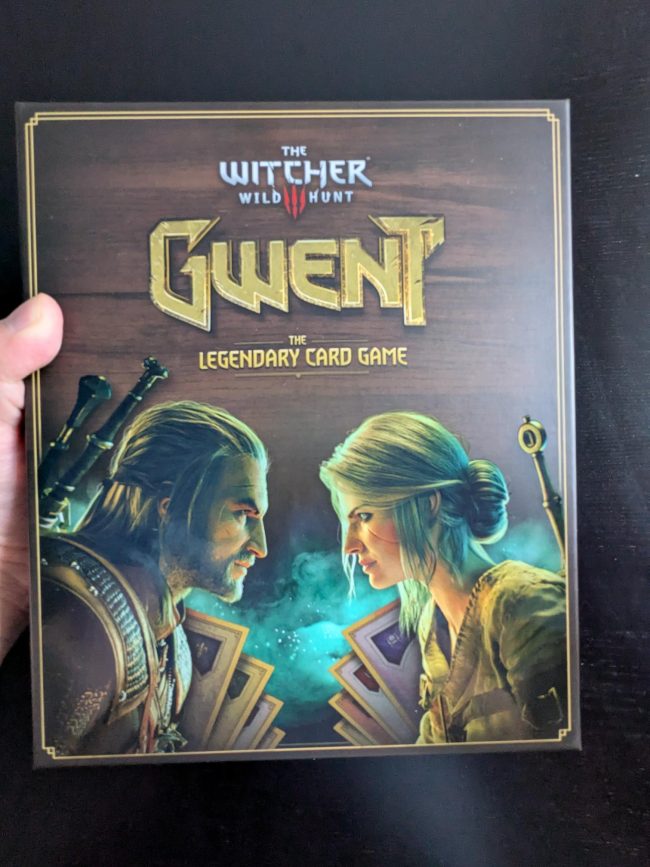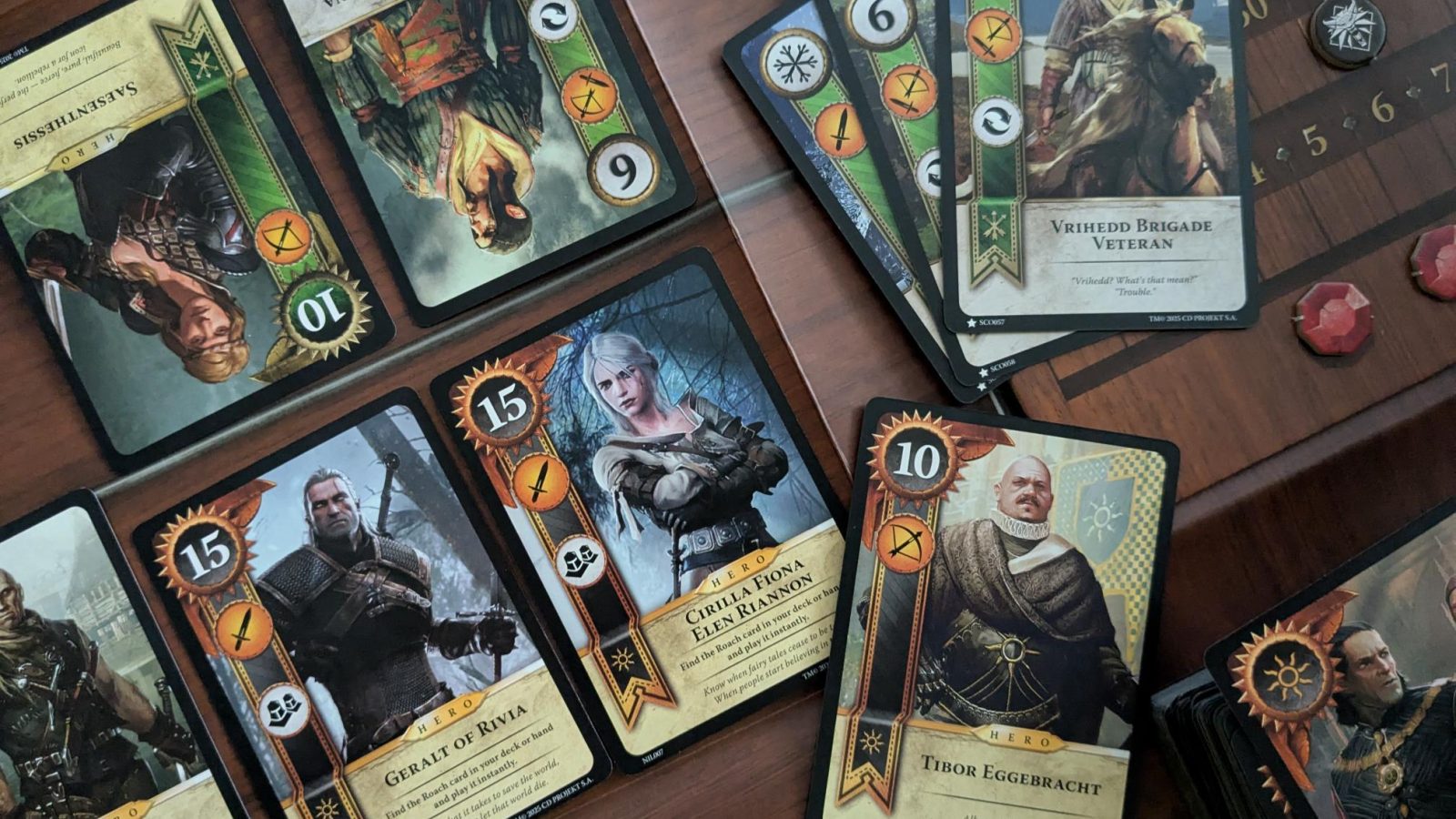
Witcher veterans know what the Wild Hunt was really about. No, it wasn't about reuniting with Ciri or slaying monsters, of course. Geralt's main priority was to challenge all his friends to a round of Gwent - the mini-game that took the gaming world by storm almost a decade ago. Since the release of Witcher III in 2013, the addictive card game has been revitalised in a standalone game and Gwent's beautiful card art has been printed by avid collectors around the world.
It's always been a given for Gwent to take the physical cardboard leap from the digital world, especially for me, who's been playing Gwent for over a decade. So now CD Project Red has realised the dream of an official Gwent game that you can play in the nearest pub or at home in the kitchen over a beer. Finally, I thought when I first opened the brown game box and coloured my living room table with the Witcher poker equivalent. Finally, I could share a joy that has been so deeply rooted in my gaming repertoire!
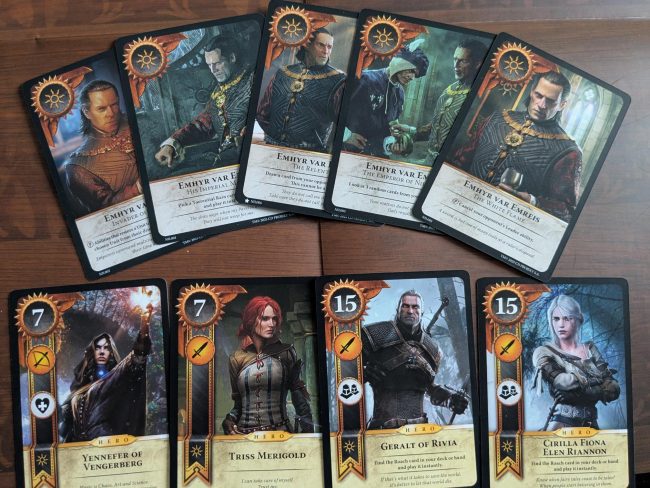
The leader cards at the top give the player unique abilities, while the hero cards allow you to protect your strength points from your opponent's effects.
After about twenty rounds of Gwent, however, I feel most torn by the legendary card game. I can't shake the feeling that Gwent was only meant for digital use, because the physical Gwent format mostly shows how old and rigid the concept can really be if not adapted correctly. The concept is the same as in the mini-game: you start with ten cards and place cards in three different rows to spread out your points (you don't want to collect all your eggs in one basket). This is done in three rounds - whoever manages to collect the most points in two out of three rounds wins! So far, this is not a problem.
In the physical format, however, the deckbuilding mechanics themselves suffer because the strategic differences between the game's various factions are minimal. There are some nice quality cards, it must be said; you can either play as Nilfgaard, Scoia'tael, Northern Realms, Monsters and Skellige, with the same beautiful character art from the mini-game adorning the thick cards. However, the majority of the cards have no abilities in them and all factions sit on identical cards. In the minigame this worked well for being able to use the same cards between factions, but in physical format there is a distinct lack of identity and the tactics quickly become repetitive. What sets the factions apart are the leader cards, where you get to choose from five different leader abilities to give yourself a unique edge. Yet there is a lack of strategic depth here.
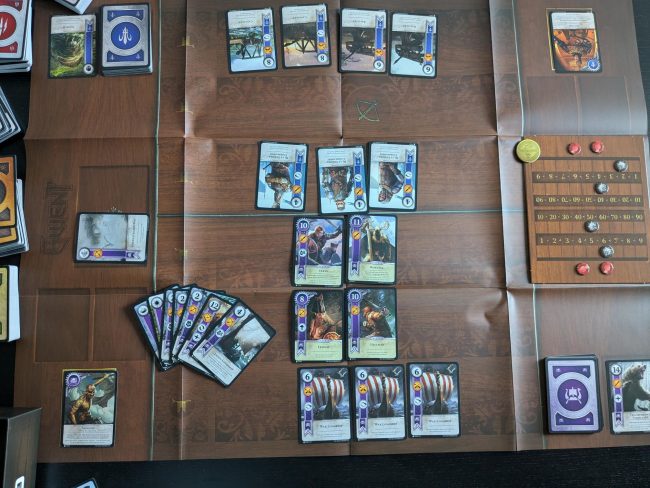
Anyone who has played the mini-game from Witcher 3 will feel right at home here, even if it is clumsily laid out.
This was something CD Project Red understood right away when developing a Gwent spinoff for the mobiles (the version I play on a daily basis), where each faction has unique cards that blend with the factions' different personalities. Nilfgaard goes all in on spies and destroying opponents' decks, while Scoia'tael focused on traps and elf dominance. The same variety is unfortunately not to be found in the board game Gwent, although there are small traces of it here and there, but this was of course expected. The official board game was not meant to be anything other than the mini game in printed format, I just mean that the translation to cardboard cards does not work as well.
On the one hand, I actually appreciate the simple elegance of Gwent's design and have always done so. It's not about combining a bunch of wild card effects like in many modern card games - it's more about finding the right time to take your turn and "bleeding" your enemy of cards. It's fun to see how your opponent has prepared for worst-case scenarios, such as blasting scorch effects or well-timed spy cards. This is what the mini-game has always been about: finding a balance between the number of points and the number of cards in your hand. If you have fewer cards than your opponent, you risk falling behind towards the end of the round. Simple and elegant, as I said.
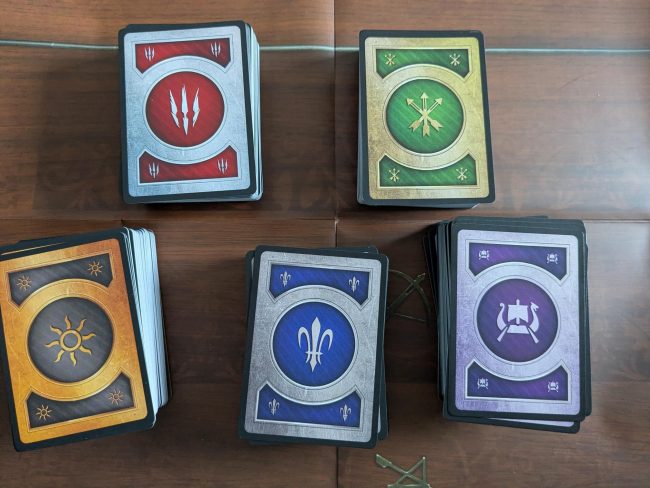
The box contains over 200 cards to play with, but many of the cards are a little too identical to really distinguish the factions.
On the other hand, physical Gwent mostly gives a flat and cluttered impression once you have to multiply a bunch of points and administer weather effects, which were handled automatically in Wild Hunt. I'm also not a big fan of the added game modes such as Free For All, 2vs2 and Solo mode, which mostly feel clunky and tacked on. The rules manual is also an unclear mess, so make sure to play with someone who actually knows something about Gwent. Considering the price tag is hefty, too, I would probably also have expected a proper game board and not the foldable paper board that No Loading Games offers.
Does Gwent: The Legendary Card Game live up to the legend? Yes and no. It's exactly what you'd expect from the mini-game and doesn't try to pretend to be anything else, but as a deckbuilder it also falls flat. If you're just looking to own the minigame as some sort of video game trophy or if you're just looking to expand your Witcher collection, this box will be appreciated, mostly just to own all the cards that the video game spent hundreds of hours collecting. As a 25-30 minute card game, Gwent also works as a simple pastime, with the box offering ready-made decks to play with. But as a duelling game, there are much better options if you just want to play something quick and easy.
Score: 5/10
Number of players: 1-5 (best of two)
Game time: 20-30 minutes
Complexity: 2/5