
Lara Croft, gaming's most iconic lady, is no stranger to daring exploits. She's encountered all manner of ferocious beasts, cunning traps and mind-melting puzzles during the Tomb Raider series' impressive 19 year history. Her latest adventure, Rise of the Tomb Raider, will see the courageous explorer journey to Siberia in search of the ancient city of Kitezh and the truth behind immortality. But before we join her on her latest quest let's take a moment explore how Tomb Raider became one of the most successful and celebrated video game series in history with a look back at the best of the series so far.
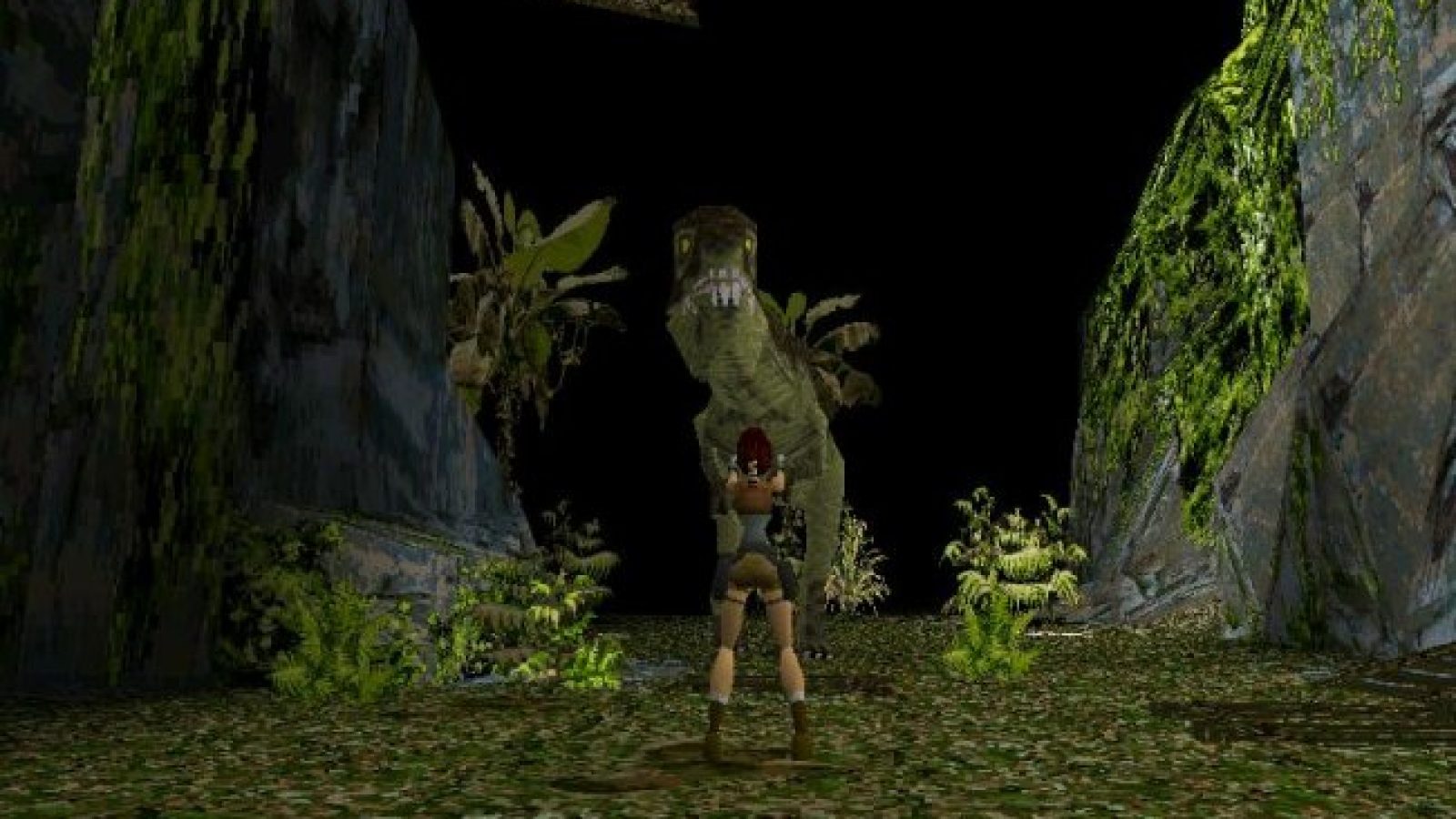
T-Rex Battle - Tomb Raider (Core Design, 1996)
Ask any long-term fan of the Tomb Raider series what their most memorable moment is and chances are they'll say Lara's encounter with the T-Rex. After two fairly brief and tame starting levels, designed to ease players into the world, the third level - Lost Valley, introduced players to Tomb Raider good and proper. Having come up against nothing more menacing than a few wolves and a bear at this point, entering the vast open expanse of the valley is a moment that will be ingrained in the minds of Tomb Raider fans forever.
Lara made her way along the valley floor only to be confronted by a very large and clearly non-extinct T-Rex bounding straight for her. Armed with only basic pistols and with nowhere to hide, few players survived their first encounter with the fearsome creature. Instead gaming's leading lady found herself chewed up and spat out like a piece of old gum. The sheer unexpectedness and immediacy of the encounter made for a truly terrifying experience. At that moment Tomb Raider was no longer a typical adventure game, but became something else entirely; a tense and challenging experience that was a true test of player's wits.
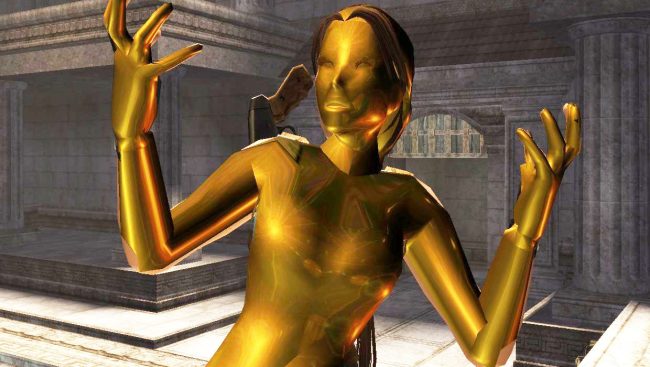
Anyone who's played Tomb Raider has undoubtedly killed Lara Croft numerous times and in many creative and gruesome ways. Whether it be impaled on spikes, crushed by giant boulders, drowning, fire, falling from huge heights, spontaneous combustion, there are literally hundreds of ways for Lara to meet her demise. The most ingenious of all however almost certainly comes at the hand of King Midas. A popular figure in Greek mythology, Midas is said to have had the power to turn everything he touched to gold.
While exploring Palace Midas, Lara happened upon a statue of the said King, lying in ruins. Combining the best of Tomb Raider's traps and puzzling, players were tasked with locating three lead bars to turn to gold by placing them on Midas' outstretched hand. The beauty of this was that those not up to speed on the Greek myth, or those that just let curiosity get the better of them, found that if they were to climb on top of the hand, Lara herself would be turned to gold. This was a simple yet ingenious idea that remains a stand-out moment in the series to this day.
Home Sweet Home - Tomb Raider 2 (Core Design, 1997)
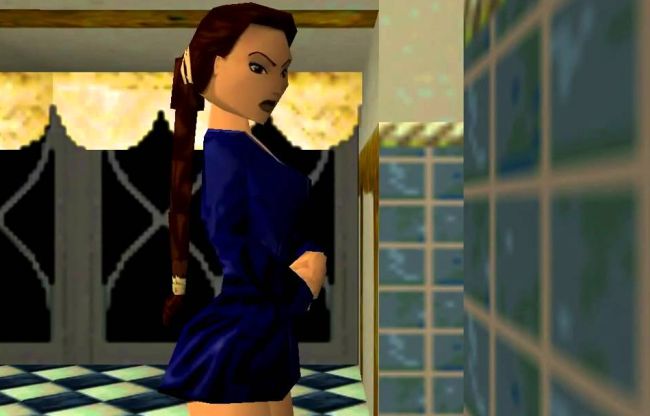
After trekking the globe from The Great Wall of China to Venice, the sunken wreckage of a ship and Tibet, doing battle with a great big dragon and acquiring the dagger of Xian, you'd forgive Lara for wanting a bit of downtime at the end of Tomb Raider 2. Unfortunately for the athletic archaeologist the followers of her Italian mobster arch rival Marco Bartoli had different plans. The final level of the game brought players back to Lara's humble abode, but this time trusty butler Winston was replaced by heavily armed goons intent on relieving Lara of her newly acquired treasure.
Luckily, instead of clothes, Lara kept a shotgun in her closet for just such an occasion. Barefoot and clad in her blue bathrobe Lara traversed her home, raining bullet fueled justice upon her uninvited guests. After the final boss was dealt with the game cut to a scene with Lara about to get into the shower when suddenly she turned to the camera, pointed her shotgun and asked, "don't you think you've seen enough?" before pulling the trigger. This level is especially memorable for its outright absurdity, perfectly portraying just what an over-the-top badass old school Lara really was.
Lara's Death - Tomb Raider: The Last Revelation (Core Design, 1999)
Core Design was tasked with creating a new Tomb Raider game every year after its initial launch in 1996. By the fourth instalment, 1999's Tomb Raider: The Last Revelation, the studio was beginning to buckle under the weight of expectation. As fans demanded more and the formula that had propelled Ms Croft to stardom began to feel stale, the studio decided made the drastic decision to kill off the heroine in the game's final moments.
After scaling the Great Pyramid of Giza and using the amulet of Horus to contain the evil god Set, Lara attempted to make her escape as the Temple crumbled around her. Met by her former mentor Werner Von Croy at the temple's exit, Lara made one last leap but failed to reach safety. Unable to pull herself up Lara plummeted to her doom as the debris caved in around her, burying her in a tomb of her own. The haunting classical score made this a beautiful and incredibly moving scene which, at the time, left fans worried that the franchise itself was doomed to become a relic of the past. Of course Lara proved much too popular for that and even death didn't stop her from having another new game the very next year.
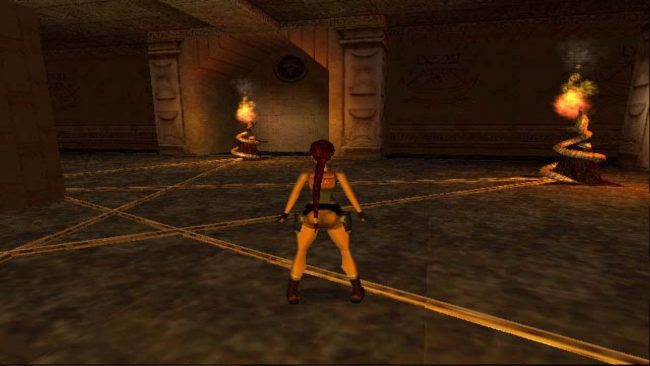
Black Isle - Tomb Raider Chronicles (Core Design, 1999)
Way before Crystal Dynamics decided to roll the years back on Lara Croft, original developer Core Design had their own take on an even younger version of the treasure hunter. 16 year old Lara was first introduced in The Last Revelation, however, the levels featuring her in follow-up game Chronicles were the real highlight. Having overheard a conversation about strange apparitions on the Black Isle, a haunted island off the coast of Ireland, a young and inexperienced Lara stowed away aboard a boat to investigate the strange phenomena.
These levels gave players a true survival horror experience, with Lara completely bereft of weapons or any form of defence except to turn tail and flee. The Black Isle's dark and eerie setting played host to some of the series' most unnerving and memorable characters. Particularly unsettling was the hanging demon - a rotting corpse found hanging by a noose from a tree that requested Lara find and return his heart. Add that to a church full of ghostly skeletons and even the Grim Reaper, and these levels provided a real scare-fest for players. The Black Isle made for an interesting new direction for the series and an avenue that, should Crystal Dynamics feel like rebooting the series once again, might be worth considering.
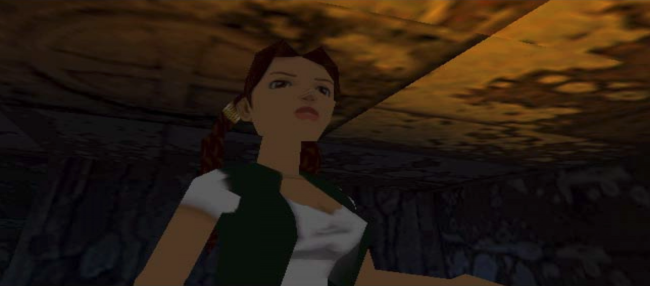
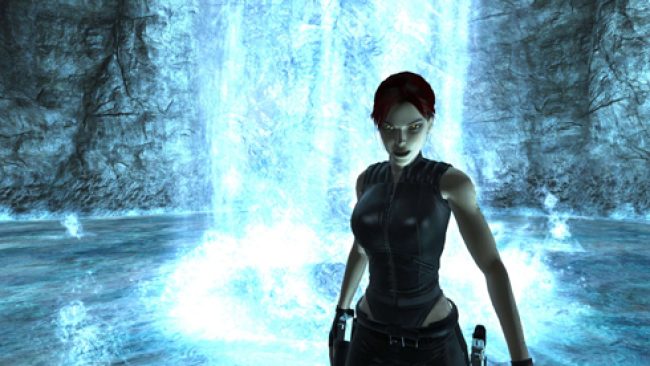
Doppelganger - Tomb Raider (Core Design, 1996), Tomb Raider Anniversary (Crystal Dynamics, 2007), Tomb Raider Underworld (Crystal Dynamics, 2008)
Lara first met her doppelganger in the original Tomb Raider. While exploring the Great Pyramid Lara encountered a being that appeared to be an inside out version of herself. This skinless, fleshy creature, fondly referred to as 'Bacon Lara' by fans of the series, mimicked Ms Croft's every move. Players were tasked with scaling the environment to an area directly opposite a lava pit in order to lure the abomination to a fiery demise. Aside from being a clever puzzle it was never explained exactly who or what the creature was.
Tomb Raider Underworld saw the return of the Lara clone, albeit with a very different demeanour. Sharing the same aesthetic qualities as Lara, this slightly darker iteration of our heroine had supernatural powers granting her superior strength and agility. The game's DLC, Lara's Shadow, gave players the chance to play as Lara's mysterious alter ego. Her superhuman speed and fire blasting abilities proved to be the highlight of what was an otherwise mediocre entry for the series. Her presence was also a delightful throwback one of the standout moments from the original game.
First Kill - Tomb Raider (Crystal Dynamics, 2013)
Lara has gone through many revisions in her almost 20 year history, but the 2013 reboot marked the biggest departure from her original design yet. With a new focus on realism, developer Crystal Dynamics wanted to show a scared and fragile side to Lara that had never been explored before. After her ship crashed on the remote Island of Yamatai, Lara found herself all alone and completely at the mercy of her captors.
Lara's first kill was a powerful and poignant moment for the series. Forced to take a life in order to save her own, her emotional reaction provided what was by far the most intense and moving moment in Tomb Raider history. Here we had a character that many of us have grown up with and for the first time ever one that we could relate to. It was a defining moment that made it clear that this wasn't the same Lara we once knew. She was a more humane character, someone with a conscience, fears and shortcomings, but still possessing that same strength and resolve to adapt and survive that first drew us to her all those years ago.
How the franchise will evolve from here remains to be seen, but let's hope Lara's next adventure brings with it many more moments of pure gaming gold.