
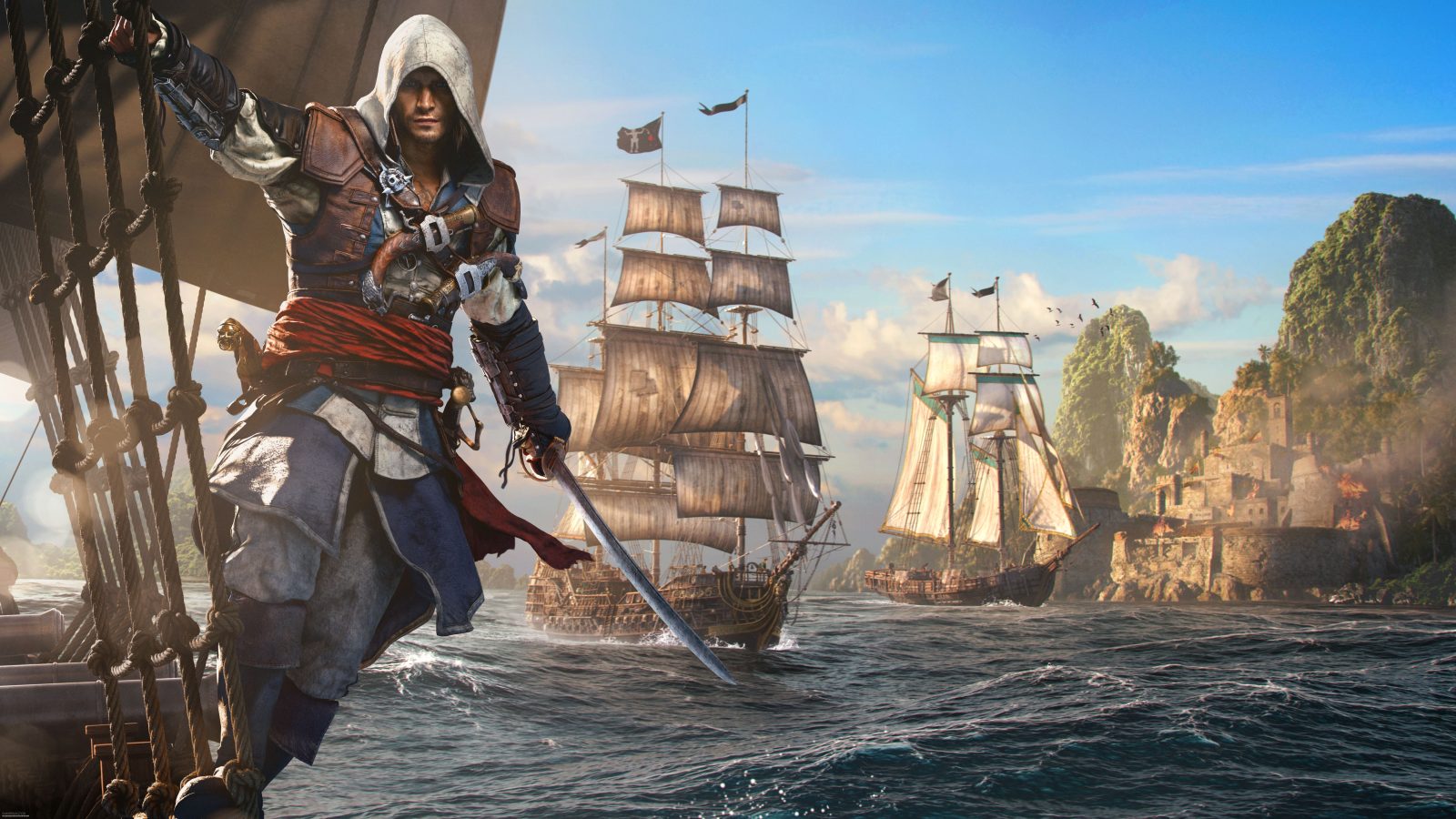
Over the years, many of Ubisoft's games, in large the Assassin's Creed series, has been built on a version of the Anvil Engine. The latest iteration of this technology was introduced in Assassin's Creed Shadows and is being used again, in an upgraded manner, for Assassin's Creed: Black Flag Resynced.
As the technology is being pushed to new heights in the imminently debuting remake, we recently had the chance to speak with tech director Jussi Markanen and Anvil Engine architect Nicolas Lopez, all to understand a little more about how the technology is being used like never before in the soon to launch title.
When queried about how the team took its experience using Anvil Engine for AC Shadows and evolved this effort for Black Flag Resynced, Markanen told us the following.
"Yeah, so we took the AC Shadows version as the base, but it was actually improved further. So we did a lot of optimisations and improvements on many different topics. I think Nicolas can talk more about the Ray-Tracing, but I will mention the water tech, because of course, water and water rendering is a big part of Black Flag. So we really put a lot of effort on improving the water rendering and the quality of the water, even from AC Shadows, which is already a very nice version of water. But in Black Flag Resynced, you will see absolutely amazing water."
Lopez then picked up by explaining: "Yeah, I could say it's the same but it's not the same, because the amount of work we did since the release of Shadows is beyond belief. And you know, we are never satisfied. Even after Black Flag, we won't be satisfied, we will push further. But from the point of view of Shadows, you couldn't play the game with Ray-Tracing at 60 FPS on the Xbox Series X and PS5 base, and on Series S, it was missing Ray-Tracing. In this one, there is Ray-Tracing everywhere. So it's the baseline. And we even brought Ray-Traced reflections in quality modes. So it's the baseline. So now the experience is much more consistent.
"It's feedback that we really took to heart, because it was a goal of ours since the beginning. But you know, at some point in development, you need to stop and ship the game. And the way we work at Ubisoft has completely changed because now the developments outlive a single production. So we knew that the work that was done in Shadows wouldn't end with Shadows, and that we could continue with the following games. It's what we did with Black Flag Resynced."
As Lopez mentioned that "developments outlive a single production", we inquired as to whether this means the work on Black Flag Resynced will tie into and set a foundation for the upcoming Assassin's Creed Hexe, to which Lopez told us the below.
"You have no idea, but I don't want to tease too much. There's one thing I would say is our virtual geometry pipeline, Micropolygon, so at this time, it only handles opaque static geometry, so mainly the environment is the bulk of the rendering. But we're doing everything we can to push it, so it becomes the baseline as well for all the geometry in the world."
You can see the full interview below for more about the technology behind Black Flag Resynced, which recently went gold ahead of its launch on PC, PS5, and Xbox Series X/S on July 9.
