
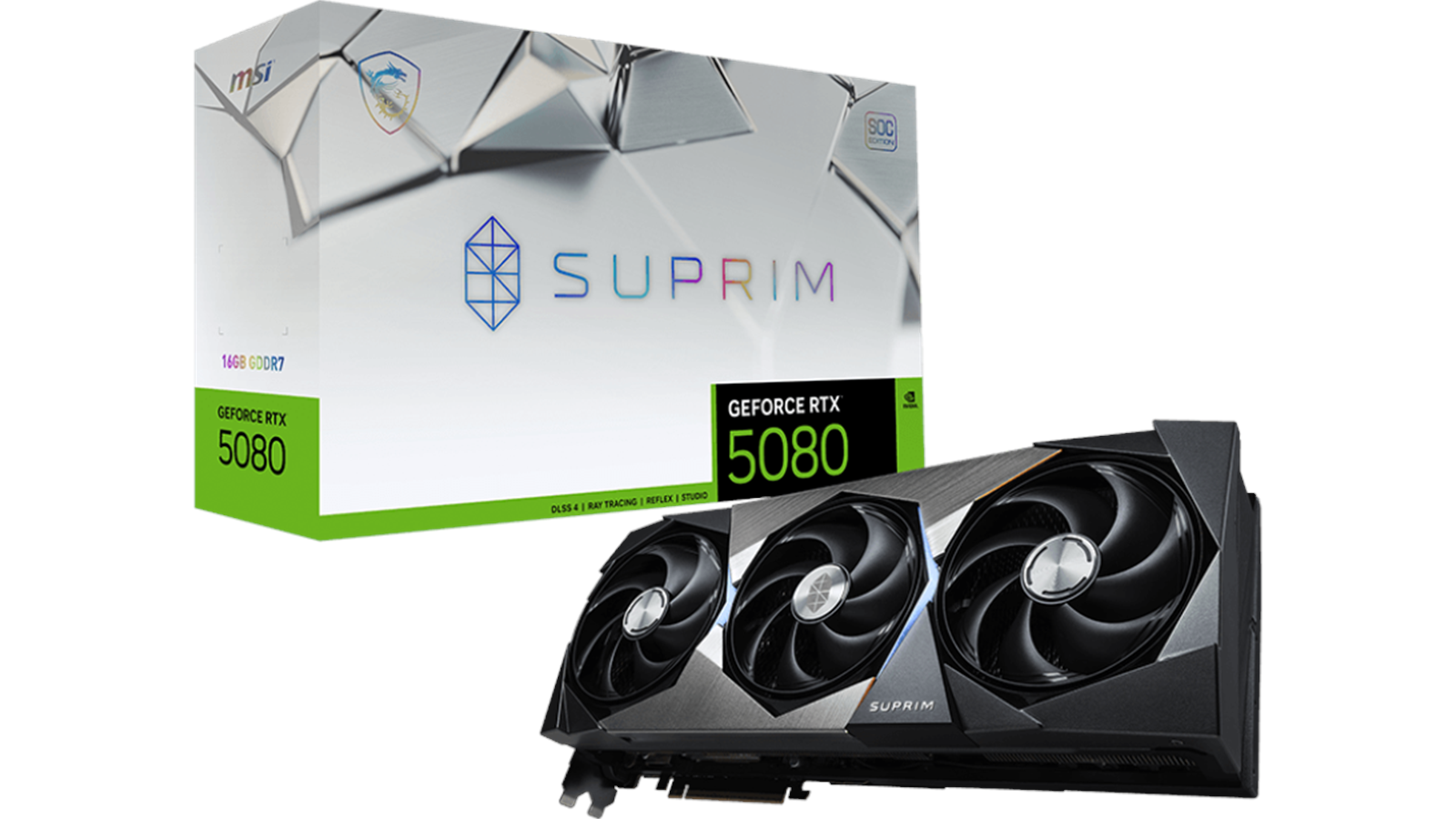
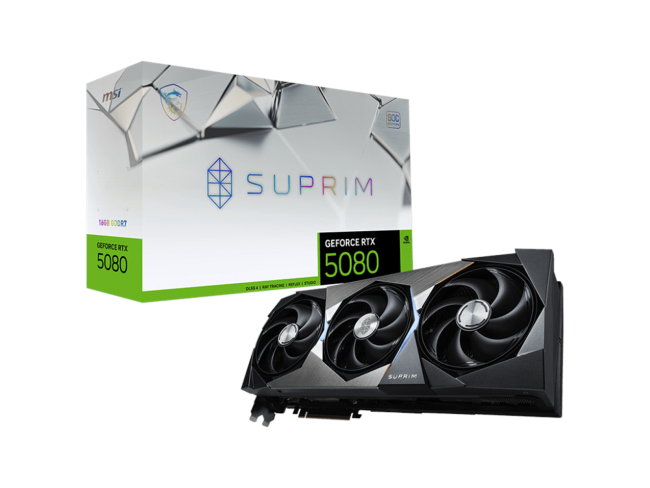
MSI's Suprim series has always seemed a little more premium than most other products on the market. Sleek design, polished surfaces, beautiful and cohesive design from start to finish. It's sharp, has industrial edges, discrete RGB, and a diamond-inspired design. Like so many high-end modern graphics cards, it's industrial and very professional in my opinion - there's a gold medal going to the designer who decided that red accents and other teenage-inspired designs need to go away from expensive graphics cards.
Inside is an RTX 5080, GB-203 graphics chip, which means 10,752 CUDA cores, 16GB GDDR7 RAM, PCIe 5.0 speeds as the bandwidth is 960 GB/s, 84 Ray-Tracing Cores, 336 Tensor Cores and ditto Texture Mapping Units, and a power consumption of 360 watts. In addition, all the modern delights are supported: DLSS 4, Multi-Frame Generation, Nvidia Reflex, and Ray-Tracing for the big gold medal. And you need plenty of space - the card is 7.6 cm thick, 15 cm high and 36 cm long. The 360 watts should be taken with a grain of salt though, we measured 398 watts, and yes, that's just for the GPU. The card maxed out at - hold on - 57.4 degrees. That's awfully low. It uses an evaporation chamber, fully optimised heatsinks, and the entire card is constructed around a central aluminium frame. It uses their new Stormforce system, which once again optimises the shape of the wings to create a more directional airflow. A special printed circuit board with extra fuses and extra thick copper tracks is used.
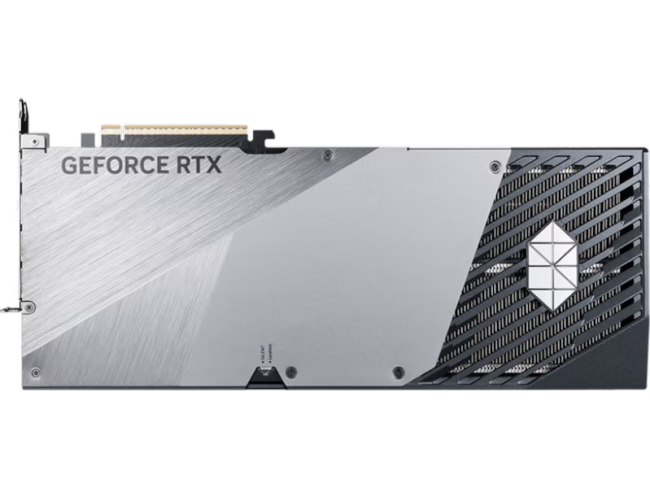
The card comes with a nice little adjustable jack-like stand, because the card weighs over 2.5 kg - that's a lot. In addition, they have also chosen to make the included cable with yellow connectors so that you can visually ensure that the cable is secure. The dual BIOS is completely unnecessary for anything other than overclocking. Even with the "gaming" setting, the card is down to around 38 dB of noise and is virtually inaudible when the rest of the system is running.
The software is... well, you have to download the entire MSI Centre, you can't just use a single driver. And it's a piece of shit that wants to take control of your entire system. Or you can choose to just have the Nvidia App installed and then optionally install MSI Afterburner, a fantastic tool I've been using for something like 15+ years that makes undervolting your graphics card a breeze, because it's still recommended until you get your power consumption under control. MSI, on the other hand, should be ashamed that it's necessary to install MSI Centre if you want the last 15 MHz with "gaming BIOS" - or you can spend 30 seconds learning how Afterburner works and then go crazy yourself. I definitely recommend the latter. However, we were lucky in the silicone lottery, as it is so wonderfully called. The card is rated at 2,760 MHz when gaming is enabled, but our loaner hit 2,895 MHz without any problems.
There were no major deviations, except in Total War: Warhammer III, where the card suddenly performed 10% faster than the nearest competitor with an identical graphics chip.
The price remains fairly stable at around £1,590. A few idiots charge more for the card, and then there are the hardcore corporate scalpers who charge excessive amounts for it. Of course, no one has it in stock at the moment. It's time for manufacturers to take responsibility and introduce maximum prices. Not all countries allow it, but this is an excellent example of how price controls could be allowed in specific scenarios.
Now for the results based on AMD's X8870e platform with a 9800X3D CPU and 32GB DDR-6000 RAM.
3D Benchmark
- Time Spy: 27436
- Time Spy Extreme: 13774
- Speed Way: 9197
- Port Royal: 22658
- Steel Nomad: 8214
V Ray 6
- RTX: 9228
Black Myth: Wukong Benchmark - Cinematic, 4K DLSS
- non-Frame Generation: 19
- Frame Generation: 35
Total War: Warhammer III
- 1080p: 231.50
- 1440p: 165.10
- 4K: 101.50
Red Dead Redemption 2
- 1080p: 180.85
- 1440p: 149.42
- 4K: 102.69
Cyberpunk 2077
Ultra settings, Ray-Tracing Ultra/ DLSS 4 + Multi Frame Generation:
- 1080p: 146.20/433.66
- 1440p: 128.32/345.38
- 4K: 91.01/246.42.74
Metro Exodus - Enhanced Edition
4K Extreme with and without DLSS:
- 4K: 60.52
- 4K with DLSS: 141.50
Star Wars Outlaws
4K Ultra Quality, with and without DLSS:
- 4K: 28.00
- 4K + DLSS: 163.00
Dragon Age: Veilguard
4K Ultra Quality, full Ray-Tracing:
- 4K: 56.00
- 4K + DLSS+ Multi Frame Generation: 139.00
Call of Duty: Black Ops 6
With and without DLSS:
- 1080p: 223.00/408.00
- 1440p: 187.00/339.00
- 4K: 125.00/229.00
{Warhammer 40,0000: Space Marine II}
4K with and without DLSS
- 4K: 69.00/107.00
{Warhammer 40,000: Darktide}
4K with DLSS and with and without Frame Generation:
- 4K: 56.00/139.00
The results are somewhat mixed. Some things are slightly worse than similar cards, others are up to 10% better. It's a bit of a mess with the results that can't be fully explained, and the reason is probably driver optimisation. Especially the games that rely on Frame Generation, and especially Multi-Frame Generation, seem to be a bit randomised.
Is Suprim a solid version of an RTX 5080 card? Yes, absolutely - quiet, cool like no other and with solid performance. It's just a shame it ended up being so expensive, but you can't buy one at the moment, so that doesn't really matter...