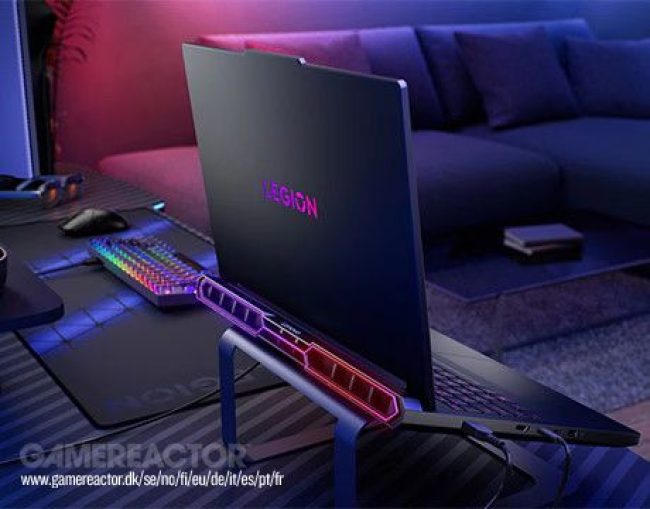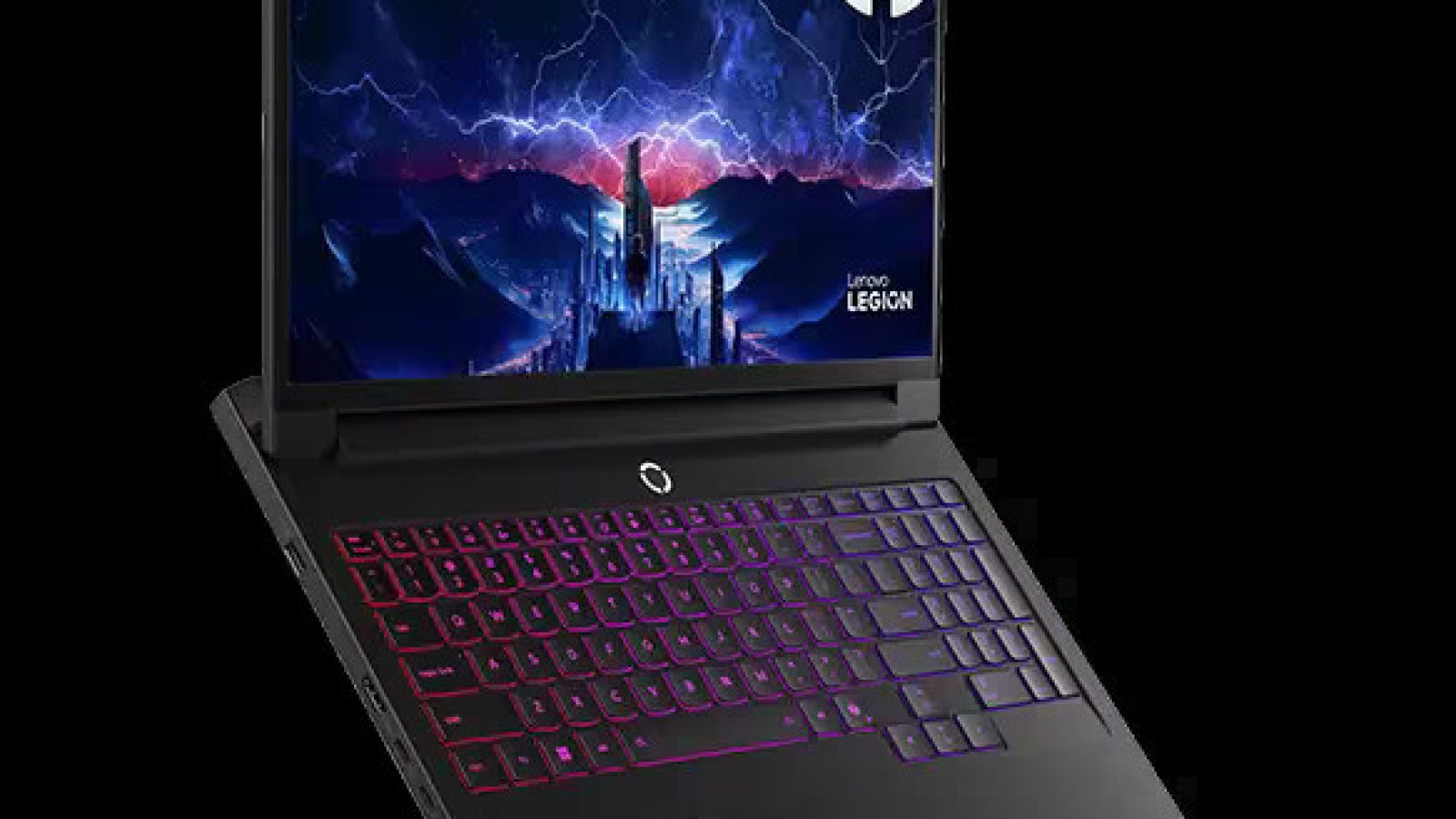
It's expensive, but Lenovo's Legion Pro 7 seems to have it all: 2TB NVMe gen. 4 - something many competitors still lack - a 16" 240Hz OLED display, a 16GB RTX 5080, and no less than 64GB DDR5 6400 RAM. Finally, a laptop with a serious amount of RAM. Personally, I wouldn't go higher than an RTX 5080 in a laptop, as the heat generation is simply too intense, but that being said, for a 10% surcharge, you can get it with an RTX 5090.
Lenovo has equipped it with a 24-core Intel Ultra 9 275HX CPU, individual RGB in each key - unfortunately still not standard in 2025 - and cooling via an evaporation chamber. On paper, it has it all, and this is reflected in the price: around £2,700. It's expensive but that's actually a fair price when you consider the performance versus the price. The only downside is that such a powerful machine weighs quite a bit: 2.7 kg, but that is almost light for a machine of this calibre.
The design is reminiscent of a spaceship or a Lamborghini, and the fan vents in particular are attractive with slightly exaggerated RGB. The downside, however, is that all the connections are on the sides, which is not a design choice I agree with.
Of course, there is also a webcam - a full 5MP - and there are many inputs and outputs. It's particularly worth noting that there is a 140-watt PD connection, so it has plenty of power. A pack of extra keyboard keys was also included. Plus points also for the speakers, which actually sound good, and a generally attractive design.
If you are in doubt about how much power this machine has, just look at the power supply: 400 watts compared to the usual 220 watts, and occasionally a little more.
The screen has VESA Black certification and 100% DCI-P3 colour coverage. But most importantly, it delivers exactly what you would expect from a modern OLED screen. Like most other laptops, it has 1600p resolution. I didn't have access to measuring equipment, but my educated guess is that we're looking at over 400 nits. However, the battery drains quickly. With active use, it only lasts an hour and a half, and with video playback, you can get another three hours, but if you're going to play games, you should definitely keep it plugged in.
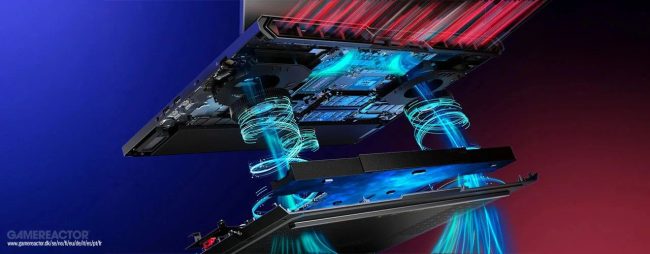
The marketing material talks a lot about AI, but it feels more like automated features that have been around for years without being called AI. My favourite is "turbocharged" fans - I'd like to hear more about how that works. It also says that a power limiter improves performance and that wording could probably have been chosen with a little more care. The same applies to the mention of "TSI cooling" without explanation. In general, the bullet-point presentation on Lenovo's website could do with a review by someone who actually understands how a computer works. I am also impressed by the claim that there is a "hyper chamber" as such a thing does not exist, unless they mean a pressure chamber, which makes even less sense. Much like the claim of "desktop performance", where the answer is clearly no.
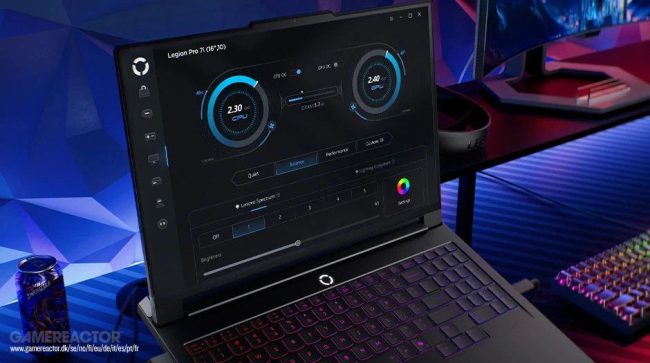
The computer stands firmly on the table, and for once, the hinges on the screen are made properly, so extra points for that. The touchpad is made of Mylar and feels comfortable, as does the keyboard, but there is no fingerprint reader or IR function. The app is not my cup of tea aesthetically. It's a bit messy in its attempt to create an overview and looks most like the dashboard of an 80s muscle car. On the other hand, it provides a good opportunity to tweak performance settings and it works fine. "Quiet" is still semi-noisy (34 dB), while "performance" is at 44 dB. You can also give the components more power - for more noise - but Lenovo has set a natural limit. The CPU reached 92 degrees and the GPU 78 degrees under full load.

Despite the powerful components, there are limits. In 1600p - which is of course what you play at with such a beast - you won't get above 60 FPS in Cyberpunk 2077 with Ray-Tracing Ultra. In fact, it's around 51 FPS, and in 1080p, you can hit 66 FPS. However, when using Frame Generation, you can easily reach 126 FPS in 1600p (2x). I prefer to avoid 4x, as 2x looks better, but if you do, we suddenly end up at 162 FPS. Red Dead Redemption 2 reached 128 FPS, which is still quite impressive. More practical for those who play competitively: CS2 runs at 250+ FPS in 1600p Ultra High.
Synthetic benchmarks:
- 3DMark Time Spy Extreme: 11,324
- 3DMark Speed Way: 5,866
- 3DMark Steel Nomad: 5,401
- 3DMark Port Royal: 14,868
With a laptop, you have to remember to limit yourself - you "only" have 400 watts to play with, but that's still far more than virtually all of its competitors. However, the Lenovo Legion Pro 7 has the advantage that a 16" OLED screen quickly makes you forget that you're using a laptop. With the RTX 5080 and Nvidia's many options for tweaking the frame rate, it's certainly possible to play with high frame rates despite it being a laptop. The price is not cheap, but with those specs, it could hardly be otherwise.
It's hard to find any serious drawbacks, apart from the battery life and the size of the charger. But that's just the consequence of powerful hardware, and it can't be changed. Would I buy one myself? Yes, probably, especially if it was on sale, or the RTX 5090 version, if I were a billionaire. But deep down, I'm just happy that 2TB now finally, after a 6-8 year delay, seems to be the standard for storage space.