
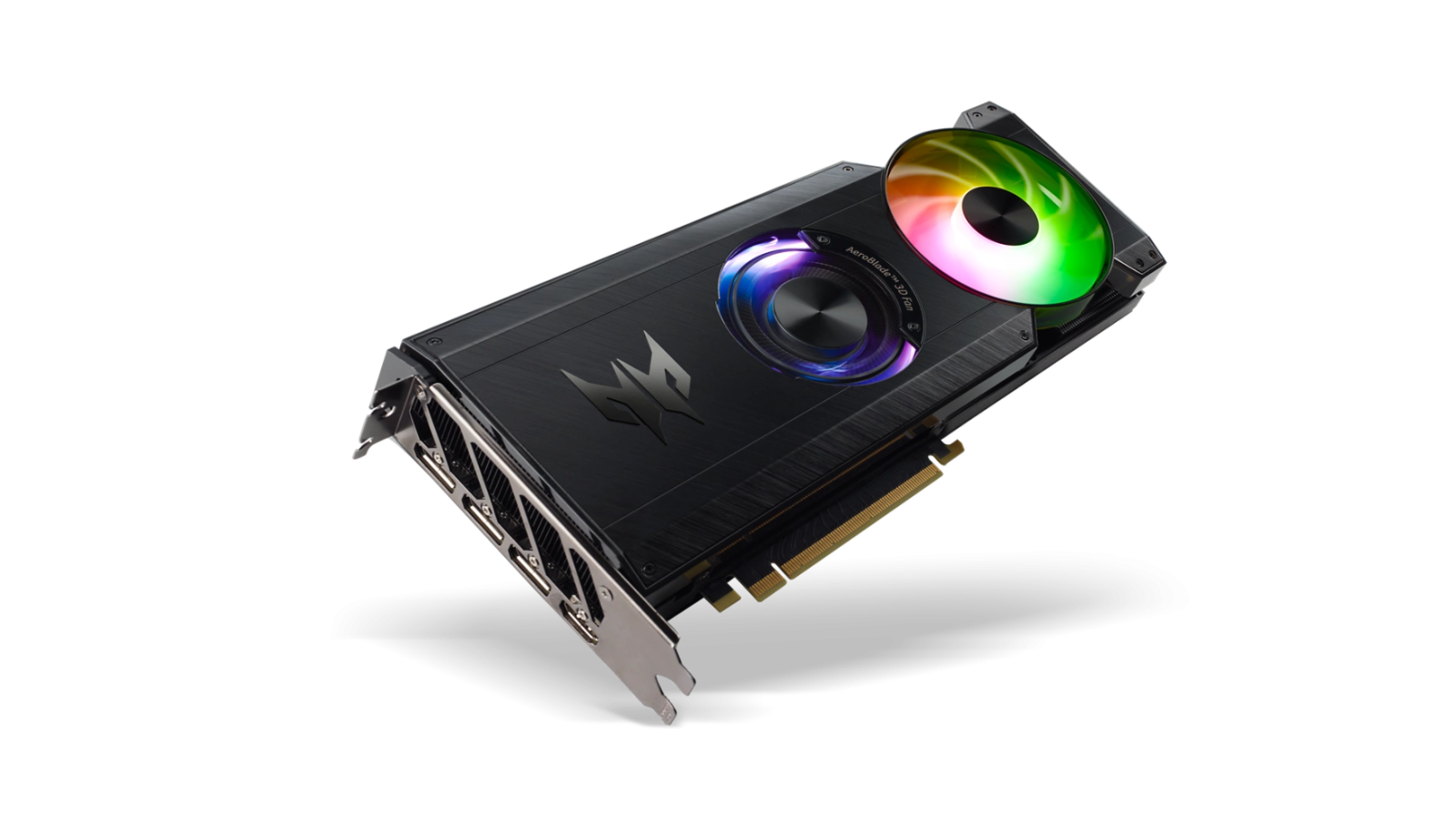
It all seemed great when Intel announced their entry in to the GPU market with their own Xe platform, being fully scalable, meaning great performance at very competitive prices, especially for those that can't spend several months' rent money on a new graphics card every year.
First it was said that Nvidia's RTX 3070 performance was the target, then RTX 3060 as Intel's Tom Petersen said "you're gonna get performance that's significantly above a 3060." More specifically, he promised up to 17% depending on the specific model/version. Petersen has been quoted for saying that prices would be lower than the RTX 3060 as well, without specifying how much - and in all fairness, what we have here isn't an Intel card, but a third party one, which are almost always more expensive.
The A770 version should be "a little bit faster" than the A750 due to a few more cores. 28 versus 32 Xe cores, to be exact. Be aware that there are different versions of each card, while the tested model is a 16GB VRAM model, one with only 8GB also exists.
As many may have heard, there were, let's call it, problems when the cards originally launched. Whether or not that delayed the third party cards is hard to say, but this beefed up Acer Predator Bifrost version of the A770 should be more or less as good as it gets before Intel moves on the their upcoming B series of cards.
The whole Xe HPG platform does hold a lot promise including AI upscaling, machine learning and Ray Tracing, but when you launch a card that is aimed at RTX 3060-tier performance, I really don't like that both Acer and Intel use the wording "high performance gaming" and "high-performance graphics." These cards launched when the RTX 3060 was mid-tier, we knew about the RTX 4000 series, and AMD's RX 7000 series was just months away, with performance that looked to excel, too.
On Paper, things look good. 16 GB of GDDR6 VRAM, 32 Xe cores AKA 32 Ray Tracing units, 512 Vector Engines, 2400 Mhz boost clock, AV1 encoding, and a normal 2x8 pins power connector, with only a 225 Watt power draw. 256-bit memory interface, and 560GB/s bandwidth, with a 17.5 Gbps memory speed are also found in this card. All in all, things look a lot better than the RTX 3060 it's compared with, actually it is in specs a lot more alike the RTX 3060Ti, although that only has 8 GB of VRAM and less memory bandwidth. And the A770 has both AV1 en-and decoding, which is novel.
Price wise - it all depends. Around my local shops, the price for the A770 BiFrost is anywhere between £399 and £449. The RTX 3060, best case, can be around 20% cheaper, even with the 12GB version, and the RTX 3060Ti is available at the same price as the Bifrost in its cheapest version. In all fairness, a non-Bifrost A770 card can be had at the same price as an RTX 3060 at my local dealer, but not cheaper as promised, but we are still talking almost 50% of the price of an AMD RX 7900XT or RTX 4070Ti.
So, what do you get for your money?
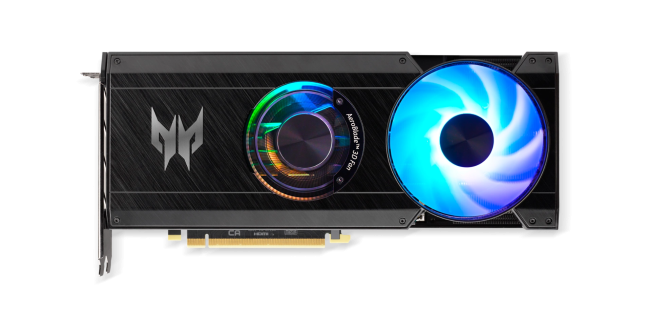
First of all, a really different cooling system. It uses a combination of a vapor chamber and a 70mm Aeroblade fan in classic "blower" style as you know it from older GPU's, this time with turbine like metal blades in tandem with a 92mm arc-shaped FrostBlade 2.0 that looks a lot more like a traditional GPU cooler, and ensures solid airflow through the screen-door cooling.
The card is pretty good quality for the price range. The FrostBlade fan is made out of semi-white, half-translucent plastic to enhance the RGB light, while the rest of the card is solid metal. The chassis is made as to add rigidity, but consideration has clearly been made towards ensuring airflow, too.
The software used is the Acer Bifrost Utility app. It works and is user friendly but is perhaps a bit simpler than I would like. A USB stick is also included with the driver software, but we installed directly from the Acer software as the initial A770 drivers were, eh, not optimal.
The card only draws 209.83 Watt at full load, with 28 degrees minimum at idling, and maxing out at 70 degrees. It's 40 Watts from the specifications which is somewhat odd. That might sound strange, but it's due to the priority of silence it seems. I simply wasn't able to measure the noise due to the fans in the computer case being louder, so, points for silence.
So, lets jump to the conclusion. The test system was an Intel 13900K-based Asus Wi-Fi Gaming Plus motherboard, 32GB 6400Mhz DDR5 memory from GSkill and all software stored on NVMe 4.0 drives.
All benchmarks are in FPS, at maximum possible settings.
3D Benchmark - synthetic benchmark
- Time Spy: 14678
- Time Spy Extreme: 7304
- Speed Way: 2407
- Port Royal: 7413
Total War: Warhammer III
- 1080p:50,4
- 1440p: 38,7
- 4K: 23,3
Cyberpunk 2077 Ultra- no Ray Tracing / Ray Tracing Ultra
- 1080p: 66,09 / 43,68
- 1440p: 52,01 / 32,32
- 4K: 30,67 / 18,3
Far Cry 6
- 1080p:85
- 1440p: 70
- 4K: 44
The Division 2
- 1080p: 92
- 1440p: 73
- 4K: 43
Assassin's Creed Valhalla
- 1080p: 93,9
- 1440p:80,3
- 4K: 53,2
Dirt 5
- 1080p: 93,9
- 1440p: 80,3
- 4K: 53,2
Red Dead Redemption 2
- 1080p: 86,49
- 1440p: 59,96
- 4K: 41,77
So, looking at the results, and comparing them with a more than two-year-old review I did of the RTX 3060 Ti, which only had half the amount of VRAM, a few things are clear.
The promise about more performance for less money doesn't hold up. Firstly, it's simply too expensive. Secondly, the performance its worse - I expect a brand-new card to outperform an older and cheaper one by at least 15%. Instead, we're looking at the opposite. It performs worse than the RTX 3060Ti by around 15% on average, with some titles like The Division 2 having a 30% FPS gain for the old Nvidia card. I had no expectations about Ray Tracing or 4K, but the card is hailed as a clear choice for 1080p and 1440p gaming, which it isn't.
This card isn't cheap. It's priced as a very decent mid-range card, and still struggles with five year old titles in 1440p. Even 1080p it barely scrapes by in some cases, and even fails in Total War which is very much CPU dependent.
How is this possible? It has 16GB of VRAM, and brand-new architecture. Looking at the 3D Benchmark numbers, it should outperform the RTX 3060Ti with ease. It has the raw computing power it needs. The only answer in my unenlightened mind is the drivers. They have been a problem since day 1, and apparently are still very much sub-par. The card clearly has the processing power needed, but is unable to utilize it fully.
It's too bad, as Acer actually did a great job with the cooling of the card, but Intel's drivers - I suspect, are still not up for it. So unless you really need the AV1 de- and encoding, you will have to look somewhere else for a new video card - and it's a massive jump to the cheapest current-gen AMD and Nvidia cards - which sit at more than twice the price.