

When it comes to delivering performance mice, Razer has actually been surprisingly consistent, but that's for better or worse. Critically, they have introduced a few too many models that cannibalise market share from each other rather than the competition, but at the same time, you have to hand it to Razer that they all perform.
The latest addition to the esports line-up is the Viper V3 Pro, and it's a pretty direct continuation of previous models in that particular series. This means we have the same praise to hand out, and also the same key criticisms.
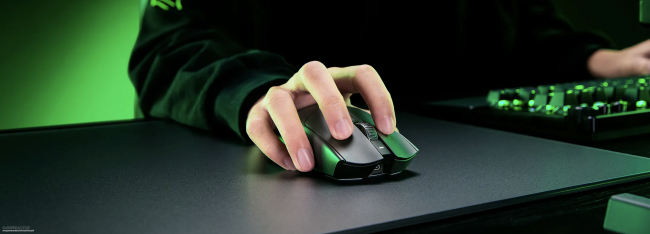
Firstly, it's very impressive that Razer has got the total fighting weight down to just 54 grams, which is six grams less than the Logitech Pro X Superlight 2, and that's without resorting to honeycomb design. It's also extremely impressive that Razer can offer up to 95 hours of battery life wirelessly without impacting the weight.
There are some pretty magnificent specifications to be found under the paper-thin shell. Whereas Razer previously offered up to 8000Hz Polling-Rate as an optional extra, it's now standard via the included dongle (more on that in a moment) and their own 35,000 DPI Focus Gen 2 sensor is also excellent. There's also the Gen 3 version of their Optical Mouse Switches, which are extremely tactile and fast, and the whole shebang is made with up to 85% PCR (recycled plastic).
If you choose to shell out €179.99, you'll get a mouse that will undoubtedly deliver on that granular esports level where every millisecond counts. However, if you also want a mouse that offers a dexterous and versatile user experience, then I'm afraid Razer may have gone a little too far in terms of shaving off the extra grams.
You see, that "dongle" I mentioned earlier is not a traditional USB-A dongle. It's a small device with a USB-C female input. Of course, you get a C-to-A cable (why it's not C-to-C is beyond me), and that way you can use this cable to get a wireless experience. Of course, there is a use case here where you plug the dongle with the cable into the desktop and then forget all about it, and if that's the case, well then the redesign of the dongle doesn't change much. But in all other respects, this is the complete opposite of intuitive.
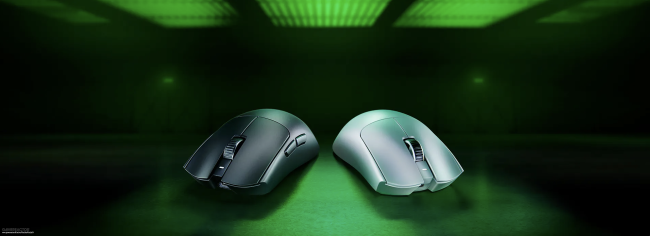
Every time you need to carry your mouse around with you, you need the mouse itself, the dongle and an accompanying cable, a cable you didn't need to carry before. Because the dongle now needs an extra gadget to work and is bigger and heavier than before, Razer hasn't designed a compartment for it in the mouse itself, which means you have to carry it separately. Furthermore, there is no Bluetooth functionality at all.
I imagine that many of the consumers who want a Viper V3 Pro will want it to fulfil more than one central purpose anyway, and that sometimes they have to move the mouse and dongle to a new location, be it to school, a LAN or some other theoretical event, and all that is now further complicated.
In all likelihood, the aforementioned Pro X Superlight 2 will be slightly cheaper, and it does weigh 60 grams, but there is also a magnetic cover for a traditional USB-A dongle, which incidentally allows 4000Hz polling rate. It's less than Razer offers here, but they have also designed a more functional mouse.