
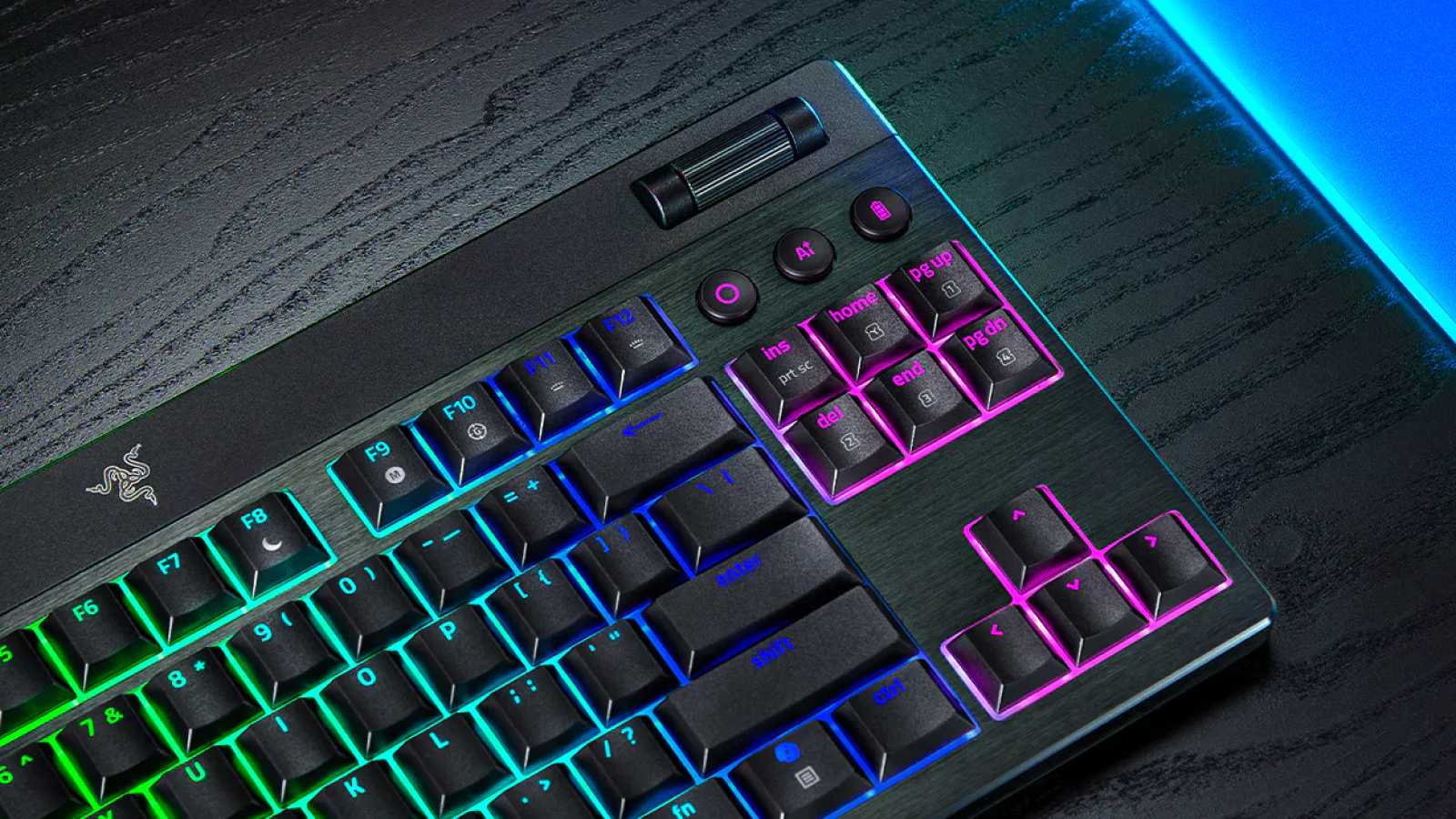
Behind the really long name, "Razer BlackWidow V4 Low-Profile Tenkeyless HyperSpeed", hides an easy-to-understand naming convention, as you get exactly what the name says. It's a keyboard, it's the 4th-gen BlackWidow, it's low profile, it's TKL, and it uses Razer's HyperSpeed wireless system. There is, however, more to it...
First of all, the design differs from the usual Razer style. It's a lot more subtle, more industrial, and the metal finish on the top plate feels more premium than usual. The design is rigid and clean, but I particularly like how the clearly marked battery indicator uses the number row to show battery level. This is activated via a dedicated button, and it's smart as hell. Why isn't this industry standard?
Razer claims "up to 980 hours—in Power Saving mode," but that disables the 1000Hz polling rate, making it unusable for gaming. Speaking of which, why no 4000Hz or 8000Hz polling rate? Other Razer keyboards can do that. Using wireless mode without power saving, you still get a very solid amount of battery life. I've been somewhat inconsistent with my usage, but at least three days seems realistic. I used just 10% in a full day, though of course that depends heavily on brightness settings and intensity of use.
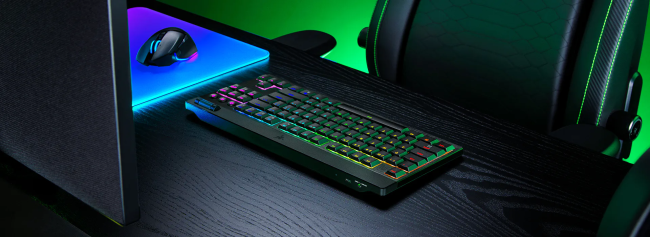
The top plate is made from aluminum alloy, with a hard plastic bottom case and internal damping foam. The overall impression is very high-end, much more premium than some of its RGB-heavy siblings. The underside also houses a small compartment for the dongle. The term "low profile" is literal here, as the keyboard is less than 2cm tall. Combined with its sleek design, it looks extremely modern and understated on a desk. It doesn't scream "gaming," but instead feels like a professional tool for computer work.
The keys—both the caps and the switches—are also low profile. There are three switch variants: clicky green, tactile (but silent) orange, and smooth silent yellow. I tested the orange switches. They aren't exactly silent in my opinion, especially on reset. Removing the keycaps shows that most of the noise comes from the sharp stop when resetting or bottoming out. The stabilisers are lubricated, which is lovely, but is really a must-have for any keyboard marketed as relatively silent.
The wireless connection works flawlessly. Unsurprisingly, Bluetooth isn't a viable option for gaming, so I stuck with the HyperSpeed dongle. It has the added advantage of connecting multiple Razer devices to a single receiver. That said, while Razer doesn't disclose which Bluetooth version is used, they do support pairing with up to three devices at a time.
I would have appreciated a low-profile wrist rest, especially given the €190 price tag.
Whether you like it or not, you'll be using Razer Synapse 4. Fortunately, it's been a fantastic piece of software for a long time. Yes, it's gamer-focused, but not in an over-the-top way. It's clearly well thought-out, with smart spacing, options, colours, and usability. Making customisation software that's both powerful and easy to use is hard, but Razer nailed it. My only issue was that Synapse wouldn't recognise the keyboard until I'd done a firmware update, but that's not unusual for review units received before launch.
I really like the feel of the keys, which is the most important part. They're extremely snappy, with just 2.8mm of travel. My main obsession with switches is reset time, how quickly a key returns to its starting position, and how much force is needed to re-activate. I have to admit that while these switches are a bit louder than I'd prefer, they nail everything else. The doubleshot PBT keycaps also feel comfortable on the fingertips, even though I tend to press harder than necessary.
It's expensive, but it's also really well made, with a great typing experience and flawless wireless performance. What more could you want?