
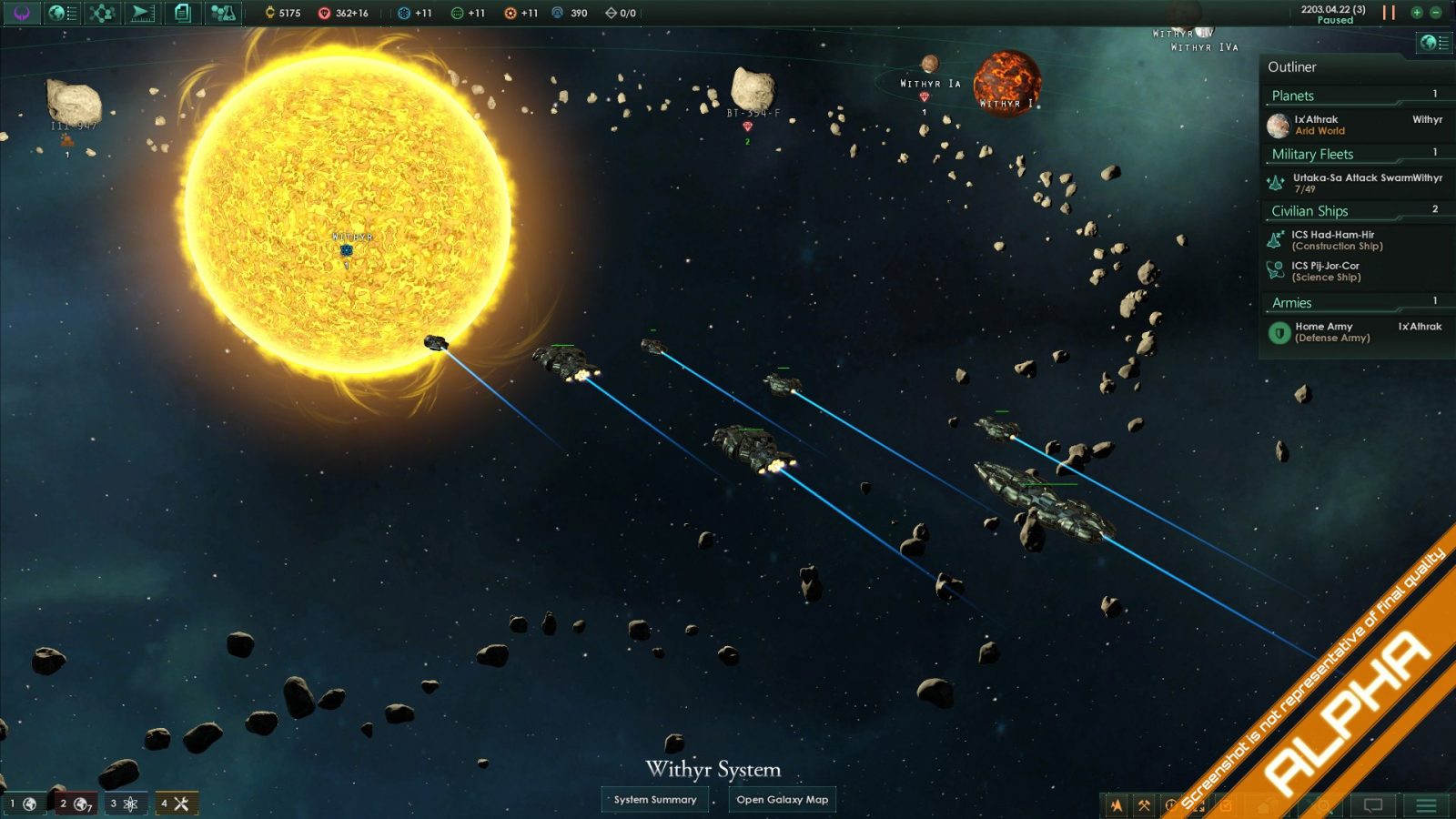
Paradox's bread and butter is history. Their in-house studio makes best-in-class sandbox strategy games characterised by rich detail and their ability to facilitate player-generated anecdotes. Stellaris takes the developer's distinctive pausable real-time formula and transplants it into a science-fiction setting, and results are almost extraordinary.
We'll quantify that "almost" before moving on to tell you more about the nuts and bolts of this galactic grand strategy. Stellaris is undoubtedly a very good game. There's a lot going on and the action unfolds at a steady pace, there's plenty of interesting decisions to make, and it represents enough of a departure from the studio's past games that it feels fresh, despite some striking similarities. Crucially though, at times it feels a little bit empty, and this manifests itself in some needlessly quiet moments.
Paradox supports their strategy games brilliantly. The long tail of expansions means that their games are constantly refined, even redefined, with new mechanics and features added through both paid and free DLCs that enhance the experience over time. We have little doubt that Stellaris is going to grow into a classic game in its own right, but the truth is that, at launch, some of the systems aren't as deep as they could have been.
We're still going to recommend that you pick up a copy, because what is here is really very good, but we're already imagining what it's going to be like this time next year once it has been fleshed out by the inevitable stream of expansions that no doubt are already in development at the studio. However, we don't want to sound overly negative, so let's take a look at what's already there and examine why Stellaris is already worth your time.
First of all, this is probably the most accessible Paradox grand strategy game to date, and it's also one of the most enjoyable. The UI isn't always as intuitive as it could be, but this is still the easiest of their games to get into. By far. Knowledge of the studio's existing titles will give you a massive head start in terms of getting to grips with the basics, but the key difference here is that you don't need to know anything about trade nodes or gavelkind succession in order to navigate the opening half of the game. A helpful assistant is on hand to cover the key points as you play, there's tooltips that offer up useful details, and there's a wiki linked to the UI that goes into a bit more detail should you need it. It doesn't cover everything, but it's still a relatively smooth introduction.
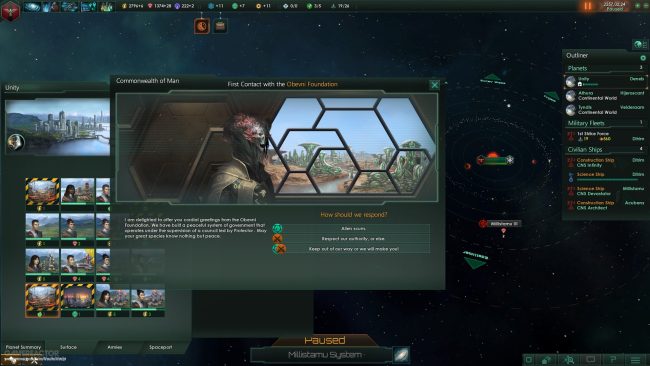
The early game is intriguing for a number of reasons. The various species are all distinct and carry traits that make them feel unique to play. To get the best out of your faction you need to role-play, and work towards individual strengths. An example of this; we played as a xenophobic and inward-looking human faction who didn't interact nicely with others, making diplomatic niceties a rarity because there's penalties if you buddy up to your alien neighbours. Other factions, however, might be more gregarious, or aggressive, or intellectually driven, and so choosing who to play as will determine what kind of game you'll have much more than the geography around you. Stellaris is more focused than Crusader Kings or Europa Universalis, with those initial choices not just dictating early game tactics, but also reverberating throughout the entirety of a campaign. (You can, if you prefer, build your own faction from scratch, and tweak the size of the galaxy and the number of opponents you go up against.)
Getting started involves exploration of your surrounding area, and settling into your local system. Science ships scurry around and scan systems looking for habitable planets and resources to exploit, and construction ships follow after to build stations of various kinds that bring in a steady trickle of income. There's scientists under your employ who research various projects at your behest. Instead of a skill tree to climb, upon completion of a project you're offered three more at random (initially, but you can unlock more options). It throws up some interesting decisions, although it does somewhat limit your ability in the early game to focus your civilisation in a direction of your preference. At the very least it keeps repeat plays interesting because you never know what you'll be able to research and when.
Resource management is straightforward. There's three main ones to worry about (Energy, Minerals, and Influence, and you can also boost your scientific output in terms of Physics, Society, and Engineering). You identify a resource on a planet and set up the relevant station to extract it. The other route to riches comes via your planets. Your home planet, or any that you subsequently colonise, is made up of a certain number of tiles - or Pops - that become increasingly populated over time, and where you drop buildings to take advantage of the resources found therein. There's no ferrying goods around, or networking things together, it just works. It's a simple and effective system, and upgrading your worlds is a gentle and enjoyable undertaking.
Once you have a certain number of colonised planets you have to start partitioning them off into sectors, at which point they're self-governed, although you can assign governors that gently steer their overall development, and you can issue planet-specific edicts that help develop them in certain ways. The main change is that you don't manage the individual Pops anymore, instead that's all automated, which streamlines things as your empire swells across the map.
Different factions have different FTL options, and the various methods of travel will impact on the way you explore your surroundings. As with all similar titles your mission here is to expand your influence, turning as much of the map your colour as possible. Here, however, the map is an entire galaxy filled with stars and systems that must be explored and exploited. There's deadly surprises waiting to be exterminated, and neighbours of all shapes and sizes to interact with. Still, we expect much more detail to be added over time, as Paradox continues to flesh out this universe with new content.
There's plenty of interesting decisions to make. For example: what will you do if you stumble on a pre-FTL species? We went all Xcom on a race of machine age avian aliens when we found them, but there's different ways of playing the scenario. There's Fallen Empires that sit on the map like coiled up snakes waiting to sink their deadly teeth into you if your borders get too close. Later on in proceedings there's crisis events that throw game-changing scenarios into the mix. In our case the galaxy was invaded by a powerful species from another galaxy. There's different events already in place, and no doubt more will be added over time to further spice up the late game.
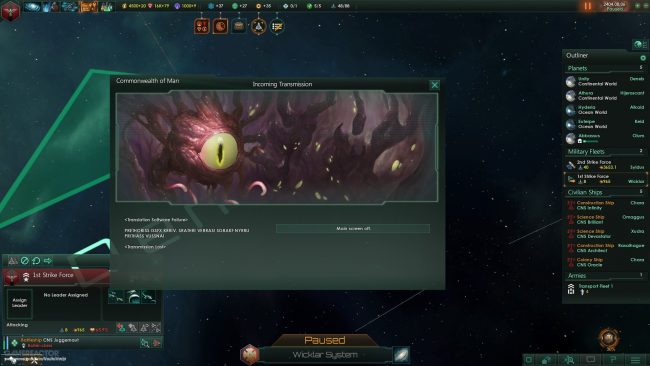

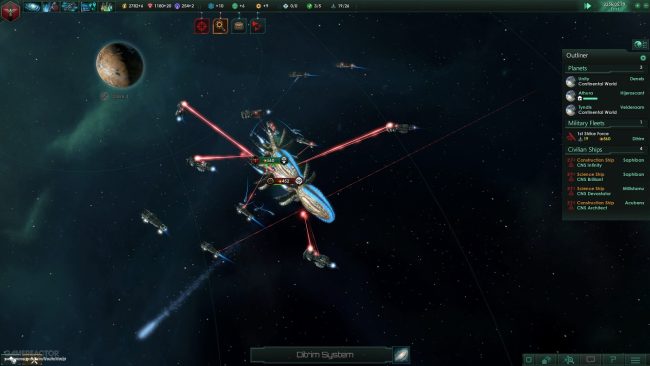
One area that we found a little harder to penetrate than others was the ship building. You can build pre-set ships and form them into a fleet, or you can design your own using the technology you unlock through research. It took us a while to get to grips with the way that it all works, but for those who like to tinker there's plenty of options available. Once you've started upgrading your space station you can build more powerful ships, and naturally you take them into battle against opposing fleets (and the odd weaponised space squid).
The combat is really straight forward, with modifiers granted through improved weapons and research affecting shield strength, weapon potency, and rate of fire, but after that everything is automated and the respective strength of your cohort will ultimately decide whether you win or lose a battle. Everything plays out in real-time, a departure from past Paradox games that had you watch numbers rise and fall: here the combat is much more interesting to watch. If you do win a battle and descend on an enemy's world you must whittle down their planetary defences before sending in an army to finish off the job. As with stablemates CKII and EUIV there's an overall warscore to satisfy before your demands are met.
There's multiplayer that offers players the opportunity to set up a galactic map to their preference and battle it out for supreme domination. Paradox games are notorious for taking a long time to conclude, so you can't play through a match in a couple of hours, rather you'll have to find a group of like-minded souls and regularly meet up for scheduled sessions, with the host saving the progress of the game. It's a neat setup, but we've simply not had time to draw conclusions about its longterm potential. We expect it to have legs, but that's very much down to community.
The main criticism we can level at Stellaris is that there's clearly more to come. Negotiation and trade need to be more nuanced, there's no religion or espionage, plus we're expecting more scenarios and late game events to spice up future play-throughs. As it stands you'd have to say that there's a slight imbalance between excitement and routine, and there's one or two unnecessarily lulls. That sounds more negative than it actually is, because Stellaris is a fine game with a lot of charm, and if you like Paradox games, you should absolutely think about picking it up. It's also worth a look if you like space-based 4X, because the studio's trademark style transitions really well into the science fiction setting and brings some new ideas to the table.
We can't wait to see where this goes in the months and years ahead, because the studio's track record implies that they'll support this, iterate on it, and refine the concept over an extended period of time. Right now this is a very good game, this time next year we expect it to be a brilliant one. Maybe not the instant classic we were hoping for, Stellaris is still a strong base upon which Paradox can build.