
Just as I was thinking that rail shooters don't get much appreciation anymore in my The House of the Dead 2: Remake review, {M2 Co., Ltd.} drops a full treasure trove of arcade gold onto the market. For those unaware, Operation Night Strikers is a collection of several classic arcade shooters from the late '80s and early '90s. Let's dive in.
Operation Night Strikers is a four-game compilation originally developed by Taito. It includes Operation Wolf (1987), its sequel Operation Thunderbolt (1989), the previously Japan-exclusive Night Striker (1988), and Space Gun (1990). While the themes vary from game-to-game, the core premise remains consistent: rescue those in danger and eliminate every possible threat.
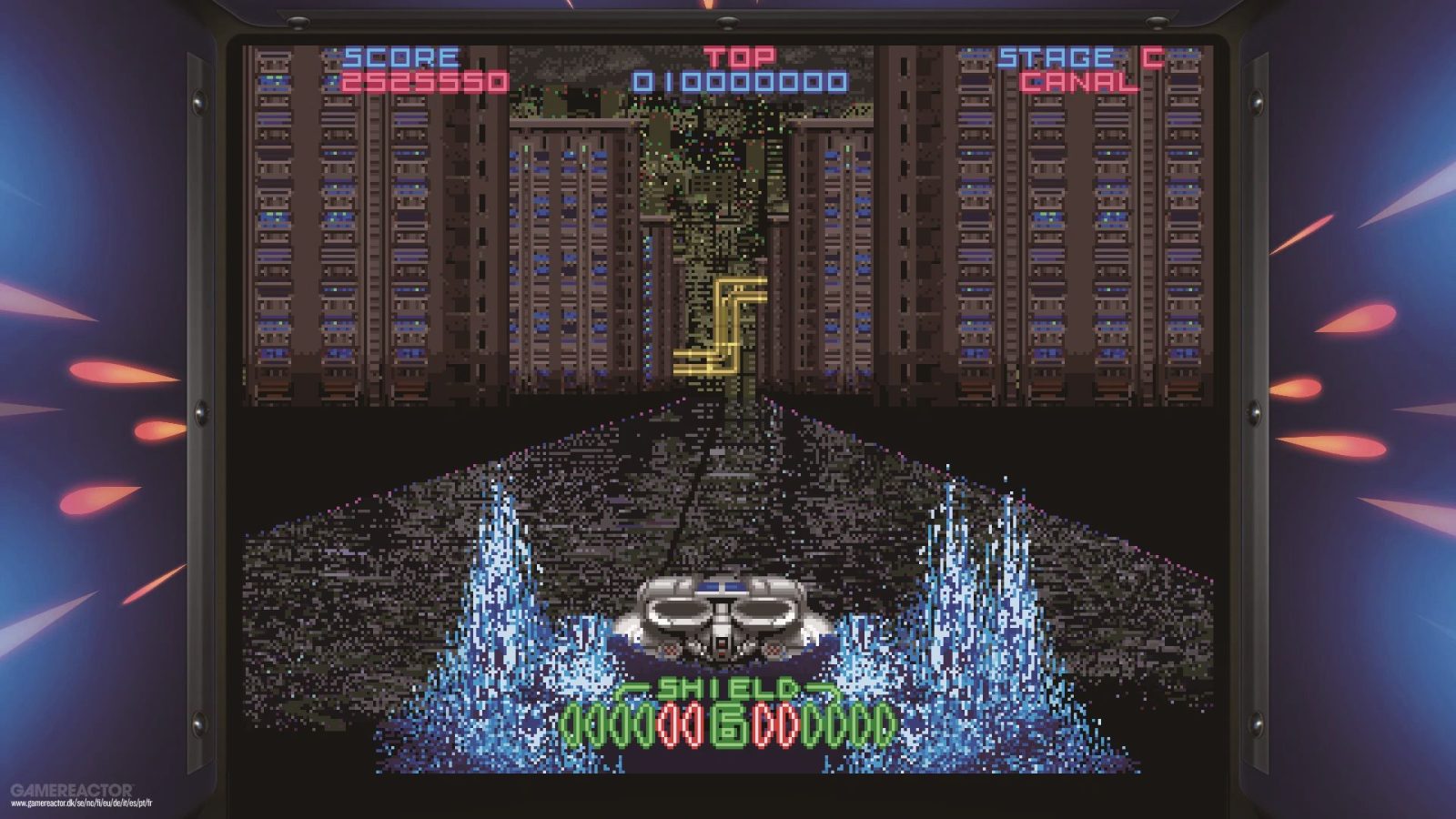
Technically, Night Striker stands apart from the rest. In this game, the player pilots a flying car-like vehicle from a third-person perspective through a futuristic cityscape. The vehicle moves forward automatically along a winding path, and the player steers in four directions to avoid obstacles and enemy fire. The illusion of three-dimensionality is created by the road's curves and layered scenery. Night Striker's gameplay feels somewhat clumsy, as the vehicle's overly sensitive controls at high speeds, combined with shooting without a reticle, don't make for the most enjoyable experience. It often feels more like a chore than a game, especially when the controls don't offer a firm grip, since the Joy-Con must be held vertically and sideways, which makes handling awkward.
The other games in the collection are nearly identical in terms of gameplay. The environment scrolls automatically, either sideways or forward, leaving the player responsible only for aiming and shooting. The idea is to react quickly to threats before they can strike, and the player can only defend against incoming projectiles like knives or grenades. Gameplay variety comes from rescuing civilians, whose frantic running across the screen must be carefully avoided during the intense shooting moments. Levels are also filled with destructible elements that reveal helpful items like new weapons, ammo, and extra lives.
Aiming is much more manageable here compared to Night Striker's vehicle-shooting combo. The reticle is controlled with the Joy-Con in a more natural position, giving the player better control and making the shooting more enjoyable. Aiming is precise enough, and even the occasional Joy-Con drift doesn't ruin the experience, plus the X button resets the reticle's position instantly, so shooting continues smoothly.
Navigating the menus is more problematic. The game seems to randomly switch controller orientation and button layout, making menu navigation confusing. Previously confirmed actions may suddenly take you back, and some menus are hidden behind buttons without any indication. This makes changing settings a bit of a hassle and can quickly wear on the player's patience.
Each game offers multiple versions to choose from, mainly differing in language (Japanese or English) and minor cultural adjustments like difficulty. The collection also allows for easier versions of the original arcade games, which is a welcome option, even though virtual coins can be inserted endlessly. Operation Thunderbolt and Space Gun also support local co-op, making it easy to share nostalgic moments with a friend, where few things match the excitement of taking down an army or rescuing civilians from alien threats together on the couch.
{M2 Co., Ltd.} hasn't reworked the visuals of Operation Night Strikers but has preserved the original classic look. The pixel graphics scale properly for modern displays, but the visual style remains just as I remember it from decades ago. It would've been interesting to see how these games might look with a modern touch, but the retro presentation works well.
Technically, all games follow a similar structure. The world is built from two-dimensional images that scroll to simulate movement, where pixelated characters are animated with a few frames to create action. Depth is added through layered backgrounds and varying scroll speeds, creating a stylish parallax effect, and the result is a warm retro shooter experience where bullets fly and enemies fall fast.
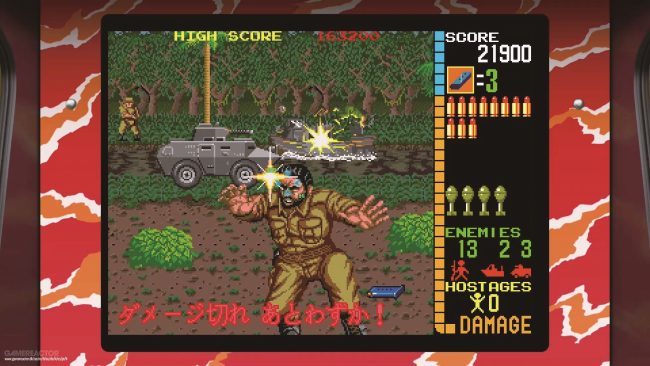
Each game adds detailed touches to enhance the atmosphere. In Operation Thunderbolt, fighter jets fly overhead, and the final mission to rescue a pilot from terrorists is memorable. Space Gun borrows heavily from Alien (1979) and Aliens (1986), to the point where it feels like a continuation of the films, with highlights including civilians transforming into aliens mid-run and shooting windows to create a vacuum suction effect, triggering automatic blast shields. Night Striker creates a convincing 3D illusion by layering buildings and scaling them dynamically, giving a strong sense of speed. All of the games run smoothly on the Nintendo Switch OLED, with minimal loading times.
The sound design is equally nostalgic. Arcade-style music sets the tone and builds tension throughout the action-packed gameplay, where sound effects have a crisp edge, adding punch to gunfire and explosions. Voice clips are low-bit and slightly comical, especially with exaggerated commands and dramatic screams. It's a fitting snapshot of the era, and for long-time players, it might even bring a tear to the eye.
Operation Night Strikers is a strong collection from start to finish. Night Striker may be the weakest link due to its unfamiliarity and less refined gameplay, but it still offers potential and a unique concept. Operation Wolf, Operation Thunderbolt, and Space Gun are timeless shooters, and experiencing them again on modern hardware, with their original feel intact, is genuinely heart-warming. The gameplay intensity, audio-visual quality, and immersive atmosphere make these games memorable, and getting them all in one package is an opportunity worth taking.