
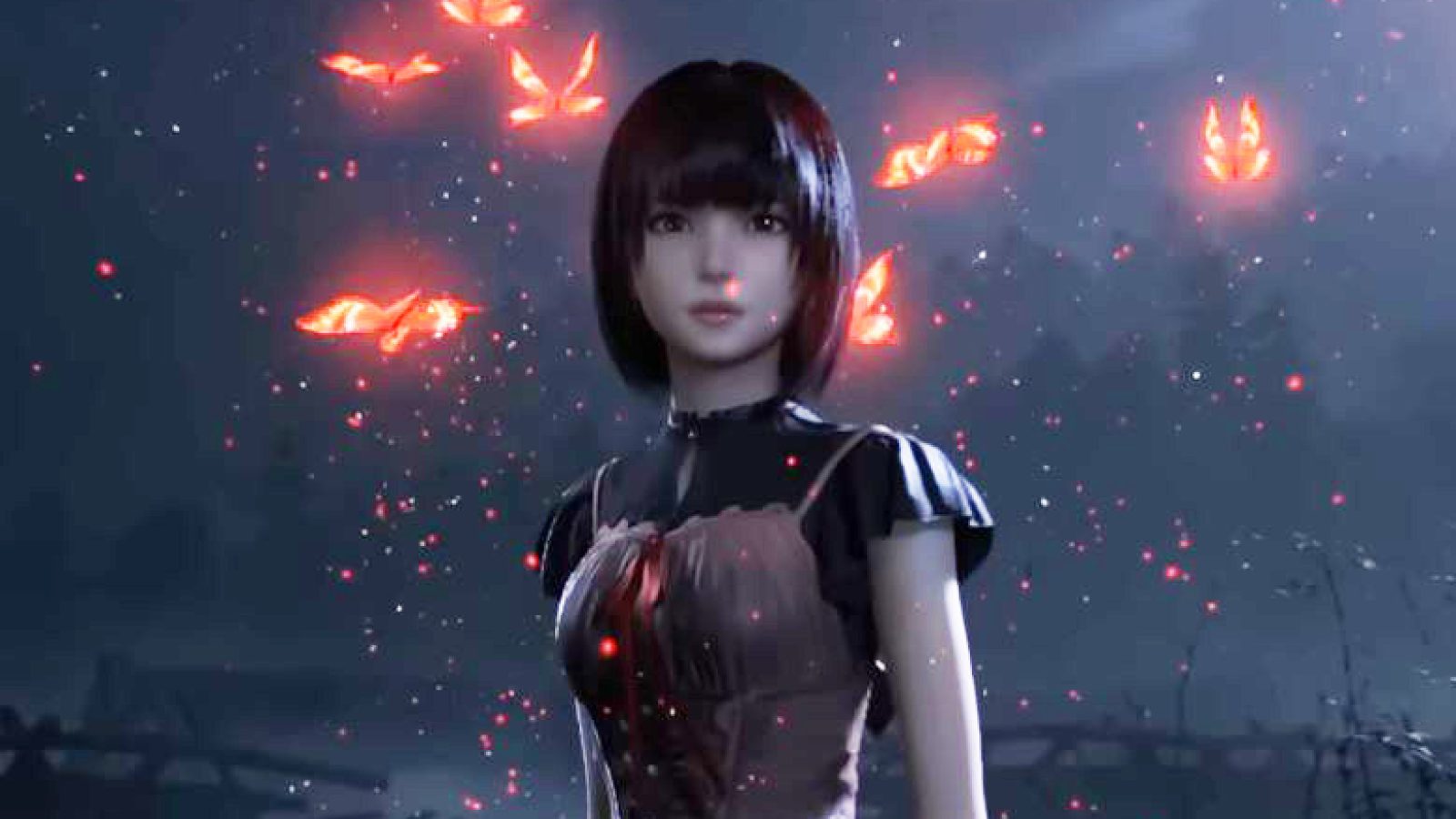
I must admit that I was a little apprehensive the first time I sat down to play the remake of Fatal Frame II: The Crimson Butterfly. The original, which I never got to play, has an almost mythical status as one of the scariest games ever made. Neil Druckmann told MCV in 2015 that he considered it "the scariest experience in any medium," and the previews that came out a month ago strongly suggested that the remake is just as terrifying.
But fear is a funny thing. Like humour, it's incredibly subjective, and compared to last year's Silent Hill f, which really got under my skin, I never found the village of Minakami and its ghosts particularly terrifying. Partly because transparent spirits are not one of my sensitive points, but also because the game's central mechanic, where you use a mysterious camera to exorcise the spirits, hardened me by literally forcing me to face my fears.
But let's rewind a little. The comparison with Silent Hill f is obvious to me. When the Fatal Frame series debuted in 2001, its more famous relatives, Resident Evil and Silent Hill, had long since settled in larger and smaller American cities and drawn inspiration from Western horror in the form of Romero and Lynch. Fatal Frame, on the other hand, is pure J-horror from start to finish, with its focus on Japanese folklore and small village communities, an approach that Silent Hill f, as the first in the series, also had great success with.
Therefore, it's difficult not to have Konami's brilliant game in mind, and initially, it's not a comparison that works out well for Koei Tecmo's remake. Where Silent Hill f effectively set the scene and elegantly established Hinako's situation, the way the twins Mio and Mayu are brought into the haunted village of Minakami feels confusing because we are not really introduced to them before they suddenly find themselves in the middle of a conflict involving secret rituals and classic virgin sacrifices.
But even though the opening didn't grab me, the story slowly but surely managed to pull me deeper and deeper beneath the surface of the village to uncover the fascinating secrets Minakami holds. The game's cutscenes are admittedly too stiffly put together to really serve as dramatic highlights, but nonetheless, the story still works.
We learn relatively quickly what is going on, after which the layers are peeled away at a reasonable pace. It works because you know your purpose and the overall context, but at the same time you are curious to get more into the details and get concrete answers to the things that are initially only vaguely alluded to.
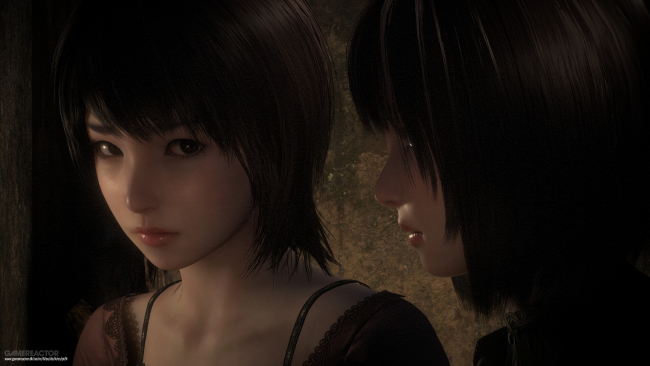
Why is Mayu almost dragged from the small stream where we meet her to the ghost town? Is she possessed by a spirit? What is the ritual performed in the town? What is it supposed to protect it from? And finally, what has gone wrong since Minakami's population now consists almost exclusively of ghosts?
There is plenty of captivating mysticism and frightening occultism, but also a recurring thematic line where duality takes centre stage. In this respect, the mythology and storytelling lean heavily on Silent Hill, and the general tone is also quite similar to Silent Hill. Traumas are dug up and dealt with, and don't expect any humour to lighten the mood. It's meant to hurt.
As a setting, Minakami reflects this in an exemplary way. Dilapidated and shrouded in darkness, it seems designed to suck the happiness out of anyone who visits it, but when the moon peeks out and illuminates the reeds in a field, you get small glimpses of the beauty that the town once possessed. What it lacks in size, it makes up for in rich detail, especially when you step inside buildings that range from small huts to enormous mansions. The Kurosawa House is particularly impressive with its equally intricate and believable architecture, where shortcuts open up while overly elaborate mechanisms set up puzzles of the kind you would expect from Resident Evil or Silent Hill.
I have mentioned the two series several times, and Fatal Frame II: The Crimson Butterfly Remake fits in well with the classic survival horror tradition that the two more famous series are synonymous with. The path to the truth is paved with a mixture of exploration, puzzle solving, and combat, but while the first two elements function as the genre dictates, it's the latter where Fatal Frame II: The Crimson Butterfly Remake goes its own way.
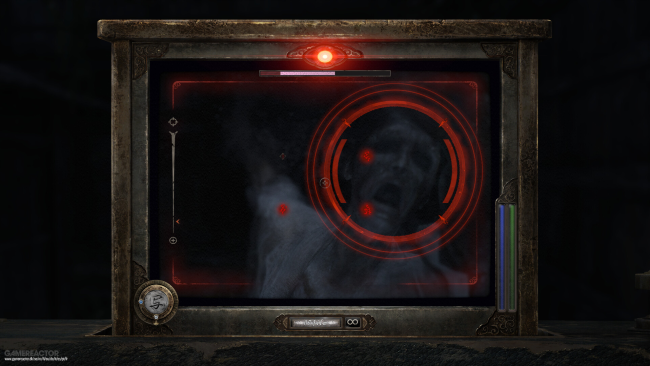
Early in the game, Mio finds a strange camera, Camera Obscura, which turns out to be able to dispel ghosts by taking their picture. Out-of-focus pictures of the ghost's backside do not do much damage, while a sharp close-up of the face quickly sends the evil spectre on to the next life. This forces you to get up close and personal with your fears, which can seem scary, but for me it quickly resulted in desensitisation due to frequent exposure. As we all know, the scariest things are the ones you can't see, and even though the ghosts are transparent, it's not enough to keep them scary. One exception is the invulnerable Kusabi, a creature born of intense suffering that chases you from time-to-time in classic fashion. As always, introducing an enemy you can't get rid of works well, but I wish the escape sequences weren't as basic as they are.
In essence, the camera-based combat system is actually less esoteric than one might be led to believe, because it's still about pointing and shooting and preferably hitting the head. And the different types of films and filters are basically like different weapons. That said, it's still a fresh way to construct a combat system, and there are actually many elements to consider. For example, certain types of film reload faster than others, and if you have the nerve to take a picture at the last moment, it deals extra damage. Although I think the fights tend to drag on a bit too long, I was surprised at how satisfying it can feel to open up a ghost for a series of "free" attacks that require neither film roll nor reloading, and the camera is a thematic stroke of genius, as ghosts cannot, of course, be damaged in the normal way.
Camera Obscura is also useful outside of combat, since the aforementioned filters all have a special function. One, for example, can open secret passages if you recreate a specific image, while another can see through walls and reveal ghosts before they see you. In this way, the camera is woven into almost everything you do - combat, puzzle solving, and exploration - and establishes itself as a cornerstone rather than the gimmick it could have been in less skilled hands.
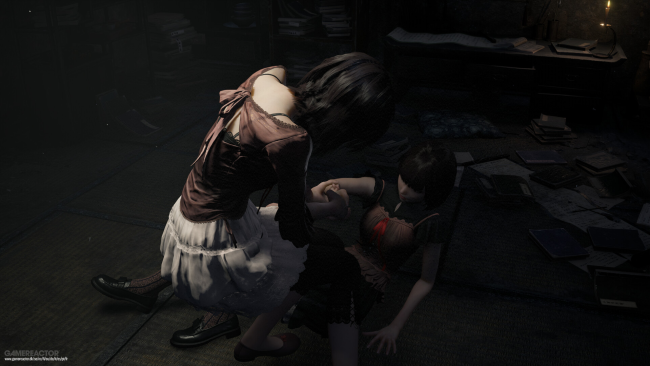
As far as I can tell, the camera's function is very similar to that of the original, but Koei Tecmo has moved away from static angles to a more modern "over-the-shoulder" perspective, and they have implemented the ability to hold Mayu's hand. This should have been included in the original, but the developers couldn't get it to work properly at the time. To be really harsh, I would say that they still can't really do it. I love the idea, which is reminiscent of ICO, but I'm less enthusiastic about the execution. Let me give you an example. When Mayu crawls out of a hiding place, she turns out to be the calmer of the two, resulting in a considerable wait, and when you finally take her hand, the pair often has to be turned around in a clumsy manner. Overall, the controls are clunky, perhaps because there are simply too many animations, which makes the game less responsive than one might hope.
If I may bring Silent Hill f into the discussion again, Hinako lacked weight, but I never struggled to control her. I do at times here, even though the actions I perform are quite basic. In Fatal Frame II: The Crimson Butterfly Remake's defence, it's almost never the clunky controls that lead to the game over screen, but it would have been nice if exploring Minakami had felt a little better. It would also have been nice if the technical state had been a little more solid. The frame rate is somewhat inconsistent, and even though I was playing on PlayStation 5, the game was surprisingly slow to load my saved game at startup and after a death.
I started out with a nerdy kind of humble brag that Fatal Frame II: The Crimson Butterfly Remake scared me less than I had feared (hoped?), but let me state for the record that it still has a few good tricks up its sleeve. When you slowly (here the slow pace works) open a door and are met by a woman with her head half cut off, it makes your body shudder, and then the damned town in all its desolation is a chilling place to be.
I wish Koei Tecmo had tightened up the controls and pace a bit, because it gets a bit annoying to wait 10 seconds for Mayu to slowly run through her routine of animations or be forced into a five-minute camera duel because you didn't have enough of the good film reels. In such moments, Fatal Frame II: The Crimson Butterfly Remake is more boring than it is scary. That said, it does offer a captivating world, atmosphere, and story. The fate of Minakami and its inhabitants is tragic but fascinating, which is elaborated on in the new side stories that only reinforce the narrative. Fatal Frame II: The Crimson Butterfly Remake certainly has its flaws, but it also manages to show an uninitiated player like myself why the series has earned its place in horror history, even if it can't quite measure up to the latest offerings from its famous relatives.