
The Diablo games are my baby, my thing. I've been playing the series since the mid-90s, and I've always been fascinated by the dark and sinister universe in which the games are set, so it's pretty amazing to think that, almost 30 years later, the series is still going strong, and therefore it's also a bit of an honour to be allowed to review the latest expansion for Diablo IV, namely Lord of Hatred.
This is particularly because I've spent an unusually long time in Diablo IV over the past few years and therefore had quite clear expectations of what Blizzard Entertainment wanted and needed to achieve with this expansion.
Let's start by getting the basics straight; Lord of Hatred builds on both previous expansions and the many seasonal systems that have been added over time, and when you read Blizzard's own thoughts on the expansion, it almost sounds like a sort of renaissance for Diablo IV, as if the game needed saving in some way, but I'm not entirely sure we're quite there yet. Naturally, the response has been mixed throughout the many seasons, but it's quite clear that Diablo IV has been in a good place for a long time, and so Lord of Hatred arrives at a rather opportune moment.
New content has, of course, been added, and the story continues in the same dark, heavy, baroque style one would expect, but this time there's a bit more direction to it all, particularly because Mephisto really gets to make his mark as Lord of Hatred. A more central antagonist who generally plays a bigger part in the plot gives the story a bit more weight than before. I must admit, however, that it still feels a bit odd that a game series called "Diablo" can completely avoid using its own titular villain. If you like the game series' current narrative paradigm, then Lord of Hatred will go down well. There is solid characterisation, fine dialogue and fine sequences. As is the theme of the entire expansion, it's not something that will blow you away, nor is it something that redefines the universe's basic rules, but I was thoroughly entertained from start-to-finish.
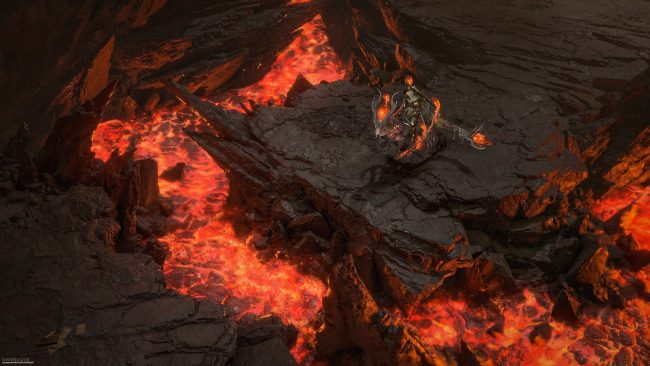
Just like the previous expansion, most of the plot and progression takes place in a new region, Skovos, which is actually quite cool to explore and which breathes a bit of new visual life into Sanctuary, without it feeling like a completely new game. Skovos is an archipelago south-west of the main area, and the place itself is divided into many different and rather cool biomes, from jungles to volcanoes. That's something.
Okay, so a specific and well-executed new visual direction? Check. But things get more complex straight away when it comes to the mechanics and structure. This is a new "product", but it's not a new "game". By that I mean the gameplay is still the same old Diablo loop. You already know what this is, despite the new skills, spells, and strategies. You also know that hundreds of monsters will come crashing down on you and that your main task is to turn them into glittering loot. Spoilers: it still works, especially because there are now even more systems where you can sit and tinker with your gear, add and change attributes, and generally keep fiddling with your items, so you can spend an absurd amount of time getting something to fit perfectly, only to find something better five minutes later. That's how we like it and it's Diablo in a nutshell.
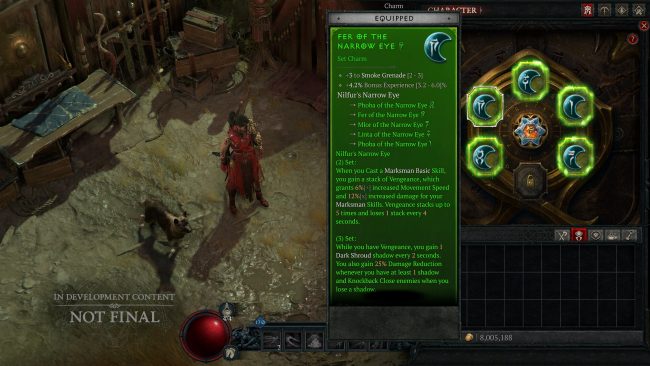
Charms have also been introduced, which provide small extra bonuses, but if you've played through the many seasons, it honestly doesn't feel like anything entirely new, but more like yet another layer on top of something we've already seen in various forms. It works fine, but it's not what makes your jaw drop.
I've mentioned the many seasons and the many content additions a few times now, and it's mostly positive. I mean, free content, added regularly? It's hard to complain, but it also means that Lord of Hatred, in some respects, feels a bit more... bare? There's plenty here, but so much of it I've been introduced to before. And it also means we can quite definitively state that nothing is really being reinvented here. You know what this is, for better or worse.
One thing Blizzard has changed significantly, however, is the stats system, where they've moved away from clear numbers and instead use percentages, and I have to be honest and say that I didn't quite understand it, even after many hours of play. I could get my gear to work, but I didn't feel I understood why the individual values affected my gameplay, and this lack of clarity is a bit of a problem in a game like Diablo, where that very understanding is usually a big part of the satisfaction, so there's a need for better explanations within the game itself. Perhaps a few examples of how these percentage changes fundamentally alter my output?
On the other hand, the skill system works far better than before, because it's now easier to see the connections between abilities and how they interact, whilst it's also becomes easier to experiment without constantly having to respec, and most importantly, you can really feel the difference when you invest in a skill, because your character feels stronger straight away, and that's one of the things Diablo still does really well. The Paragon system also works better with the rest of the game now, and it feels like a more cohesive system, with clearer synergy between skills and Paragon, which I'm personally a big fan of because it gives a sense of progression that actually means something.
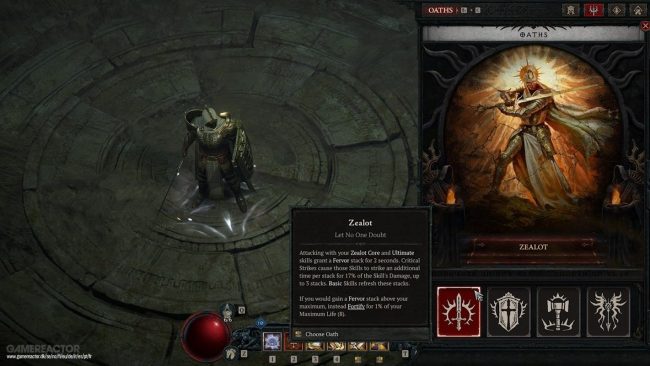
And finally, the new classes. The expansion introduces new classes, and I tried, among others, a warlock who plays with the dark forces, and a more classic paladin-type who takes the opposite path, and they offer some great opportunities for variety, even though it still feels like Diablo IV at its core, just a little more flexible. The two new classes felt like a breath of fresh air, and their contrasts with one another were pretty cool to experience.
Something that really did hurt, however, was the loot system because it feels as though it's primarily elites and boss types that drop the good stuff, and that means ordinary enemies lose some of their significance, which is a shame because I love that feeling of a random skeleton suddenly dropping something cool. Blizzard has admittedly added a loot filter, which makes it easier to sort through everything, but it doesn't quite change the actual feeling of drops. There's far less gear dropping than there was just a few months ago, and that was quite disheartening for me, being the loot goblin that I am. There's been more of a focus on quality over quantity, but I do miss the game being a bit more quantitative. It's the sheer explosion of loot that's the point.
There's still plenty to do with The Pit, Nightmare Dungeons, and new endgame activities such as War Plans, where you can chain quests together for a reward, and Echoing Hatred, so there's no shortage of content, and it only seems to be growing with every expansion. But I am a bit concerned about whether these additions are too disjointed, appearing as separate pillars upon which the game is built. Versatility is a fine goal in itself, but the game also feels more fragmented now, with a very multi-faceted identity.
That's not always a bad thing, though because this time they've made room for fishing, which can actually yield solid loot at your own level. I loved that, even though my concern still stands. In Lord of Hatred, you are constantly, uniquely aware that there are a number of parallel, separate "sections" within the content, and this can be distracting.
Another fun little thing is that the Horadric Cube is back in a new version, and it's such a classic Diablo feature that really hits the right note of nostalgia, even though here too it feels like a further development of something we've seen before, rather than something entirely new. It can transform almost anything in the game into other items. If you have three helmets, for example, you can get a new one by combining them. This means you don't end up trashing as many items as before, and it's great to see the iconic cube back.
If you're also looking for a significant graphical upgrade, you'll find it here, to some extent. Visually, the game is still excellent, and the cutscenes are absolutely stunning, as you'd expect from Blizzard, and they still have something quite special there, whilst the music works well, although I do miss the iconic themes from previous games a bit, especially the very special atmosphere of Diablo II.
All in all, Lord of Hatred is a good expansion with plenty to offer, both for new players and for fans, but it isn't the major revival one might have hoped for. It's Diablo IV, just a little bit better, and sometimes that might be enough.