
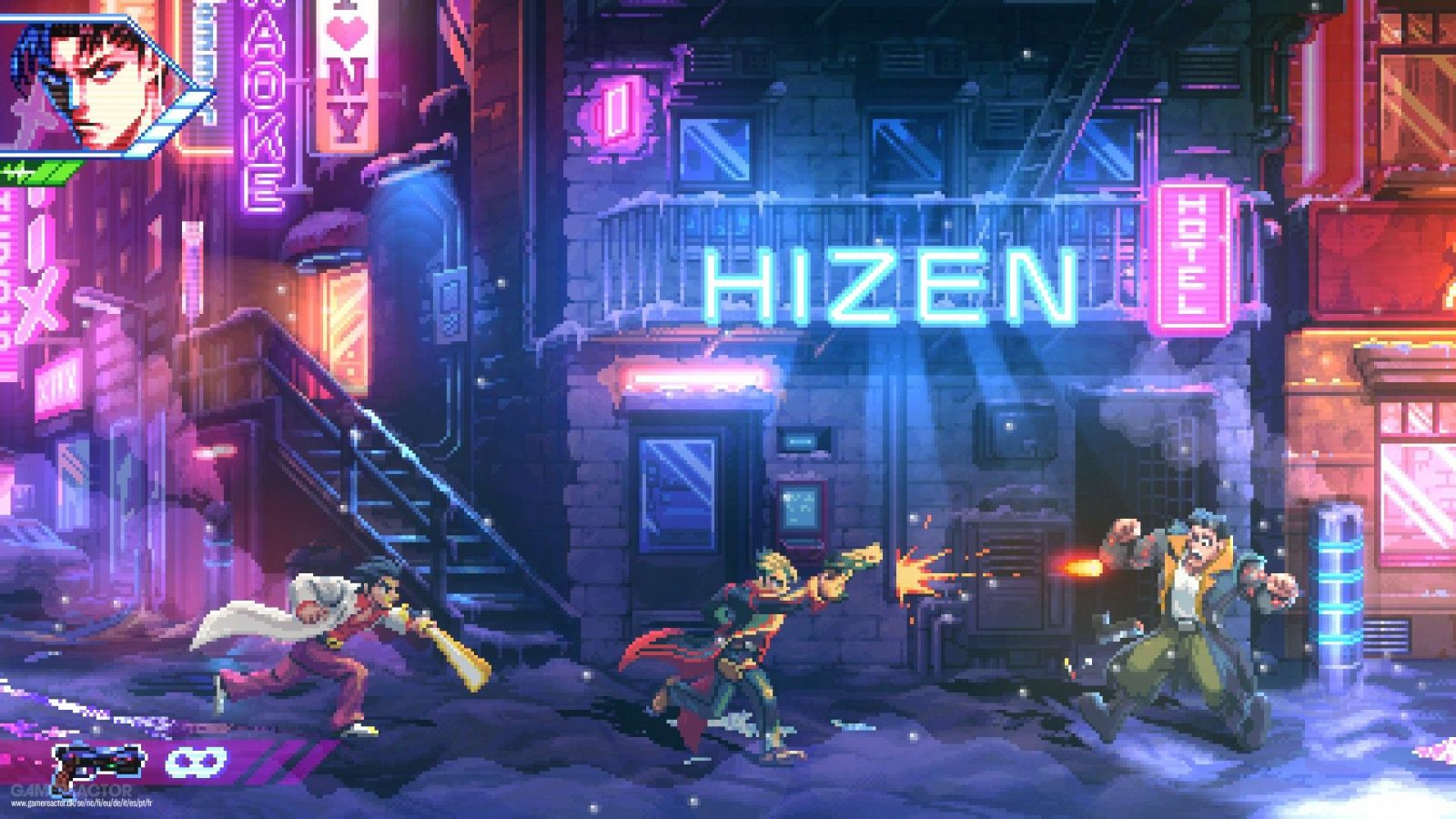
The year is 2055, and a cyberpunk-influenced, shattered, neon-lit, and chaotic New York is largely controlled by five different mafia families. Gangster-affiliated assassins (members of the Italian clan The Family) Angelo Morano and Mariana Vitti are tasked with travelling from the slums of the Bronx via Brooklyn all the way to Manhattan, killing anyone who stands in their way. We never really find out who they are, why or how the conflict arose, and that's just as well. Neon Inferno is hardly about a deep story, memorable characters, or nuanced storytelling. It's more about shooting, often and constantly, shooting everything that moves (and more).
The eight-person studio Zenovia released its debut game in the autumn of 2021, and it was, in many ways, a charmingly successful Contra clone drenched in gorgeous pixels. Steel Assault clearly demonstrated the studio's capacity for side-scrolling retro action, and now that Neon Inferno has finally arrived, Zenovia has once again taken a look at a couple of old classics, fused ideas from them and put together a cosy, gorgeous retro experience with some modern little details.
Neon Inferno is basically a mix between side-scrolling 2D action like in Contra and arcade action from, for example, Wild Hund or the Mega Drive game Dick Tracy. You usually shoot to the left or right, but sometimes you are asked to shoot straight into the screen, and sometimes both at the same moment, which, just like in Dick Tracy, means that there is a little depth in the 2D art and, above all, better variation than in, for example, Metal Slug or Eswat. The game mechanics are super simple with a few buttons whose functionality you need to learn, but the more difficult moments to master are when the enemies' hail of bullets fills the screen and forces you to jump, duck, and even shoot down the enemies' incoming bullets with your own. It's neither innovative nor original, but rather (as mentioned) borrowed directly from Contra and Wild Guns, but it works very well, and considering that the entire Neon Inferno can be played with a friend, it never feels one-sided or flat. Quite the contrary, actually.
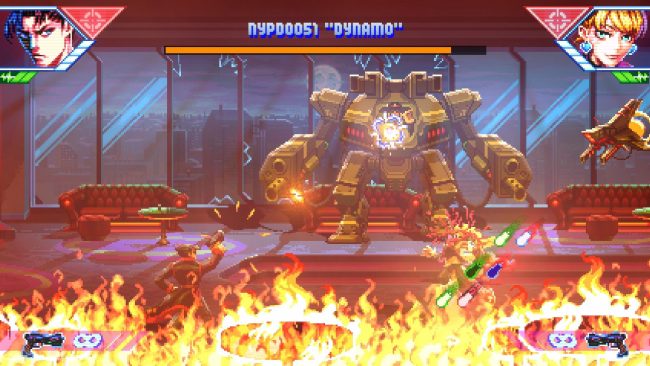
The bosses are classic and challenging in just the right way.
One of the greatest strengths of the indie genre, in my opinion, is that it is home to developers who not only want to create "new" experiences based on unique ideas, but also return to the game types and formats that defined the entire entertainment form in the 80s and 90s. As much as I enjoy titles that offer an original vision of a new type of gaming experience, I want to have as many of these delightful retro tributes as I can get with modern technology, and as much as I loved the Swedish-developed Huntdown, I am equally fond of Neon Inferno.
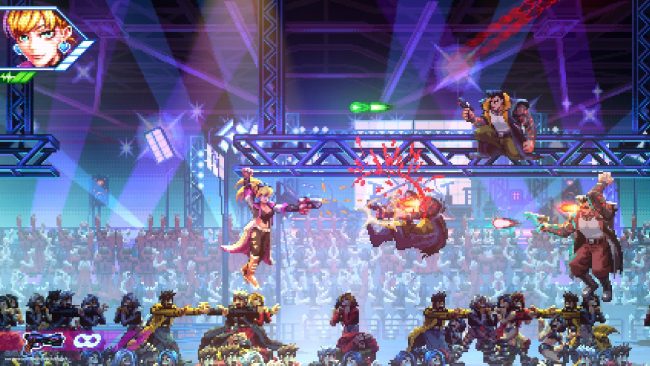
You have to fight your way through a New York (2055) drenched in mafia blood.
The design style is gorgeous, and the pixel graphics are often so well done and so packed with animated, vibrantly colourful details that I often want to stop, pause, and just soak in the fact that the gaming world once offered exclusively pixel games. Zenovia's environments are drenched in wonderfully stylish effects, you can shoot lots of things in the surroundings, and the design style is a mix between Final Fight, Streets of Rage, Turtles in Time, and Wild Guns, which appeals to me enormously. Behind the design of the main characters Angelo and Mariana is former Capcom-contracted freelance illustrator Jun Tsukasa (who is best known in Japan for his cyberpunk-influenced softcore manga), and even though Angelo in particular is just a shameless rip-off of Jin Kazama from Tekken, I don't mind. The characters, including all the crazy huge bosses, are absolutely brilliant, and there are so many cyberpunk-oriented clichés here that have been designed in just the right way. Gonzalo Varela and Joseph Bailey's soundtrack is also completely phenomenal, and brings to mind retro classics such as Super Probotector and Streets of Rage 2, which gives me goosebumps and persistent ones at that.
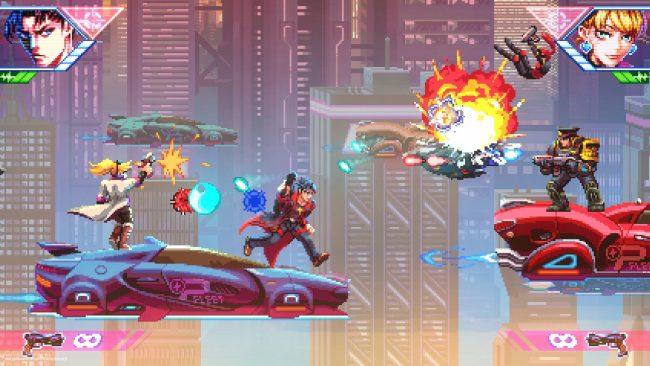
The music in Neon Inferno is truly fantastic.
It's possible to criticise a game of this type and style for not delivering enough of its own (or new) ideas. It's also possible to criticise it for not offering the same variety in terms of layout and style as many of today's action games, similar to the games that inspired it. However, for me, that would be a bit like saying that a restored vintage car isn't good enough because it doesn't have a 17-inch display in the centre console like all of today's genderless electric cars. If you do that, I think you fail to see the brilliance within. Neon Inferno is in many ways that delightfully cosy, action-packed, gorgeous tribute to all things 16-bit, and it's so obvious that the creators of the game love the genre, love the old classics, and have sprinkled this love and passion into every little pixel.